5 signals Shopify scores before an AI agent sees your product
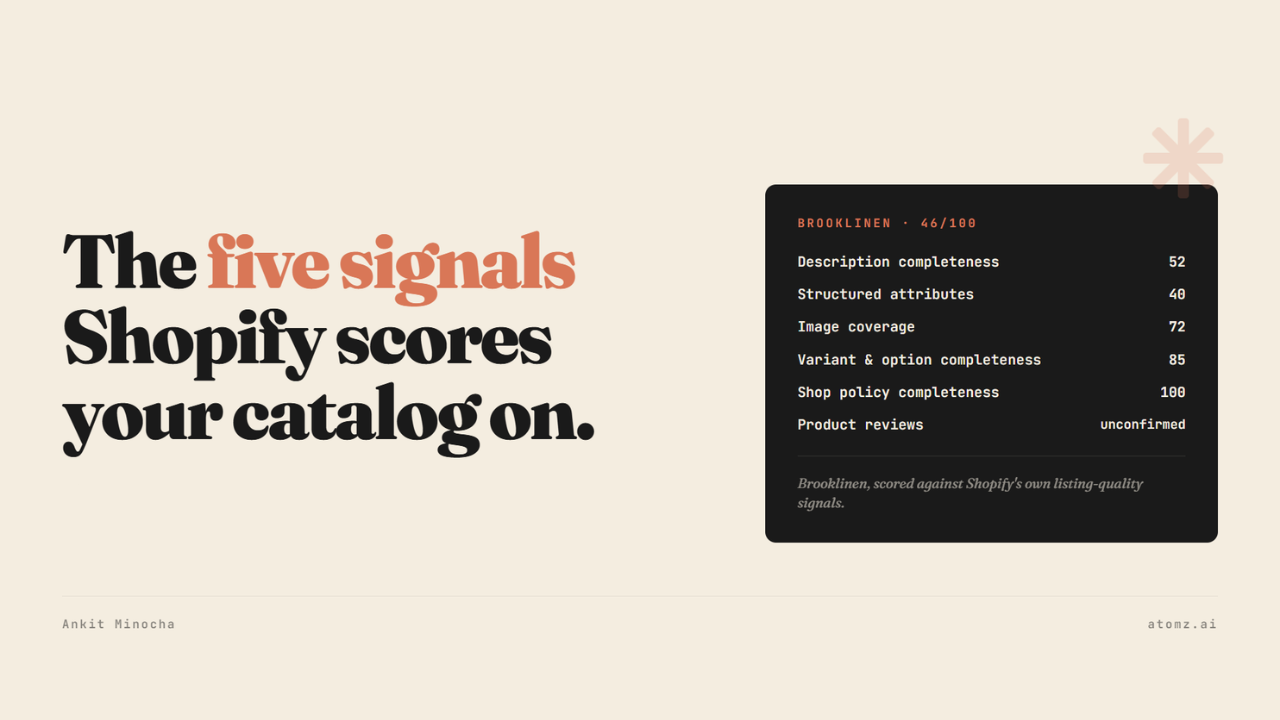
When someone asks ChatGPT or any other AI shopping assistant to find a product, the agent doesn't browse your store the way a person would. It pulls structured data from a feed called Shopify Catalog, and Shopify scores every product in that feed against five specific signals before an AI agent ever gets to it.
A low score doesn't mean the website looks bad. It means the data behind the website is thin in specific, fixable places. I ran Brooklinen, a home goods brand, on the audit tool. The score was 46 out of 100, across 300+ products.

That number reads like a brand doing everything wrong - but it isn't. 46 isn't an average of all five signals. It's an equal-weighted average of exactly two: description completeness and structured attributes, the only two Shopify's own scoring counts toward the headline number. The other three can be seen in the audit but don't move that number at all.
Shop policy completeness came back at 100. Variant and option completeness came back at 85. Two of the five signals are close to perfect. Two more, description completeness and structured attributes, are what's dragging the score down. The fifth, product reviews, isn't something a public audit can score at all.
The 5 signals (and what each one actually checks)
1) Description completeness → Shopify measures word count. A short description gives an AI agent less text to match against what a shopper actually typed. Roughly 50 words is the thin line. In the Brooklinen audit, 170 of 334 products fell under it.

2) Image coverage → More images let an AI agent represent a product across more shopping contexts than the one photo a shopper happened to land on.
110 of Brooklinen's 334 products showed fewer than 2 images. For a bedding brand specifically, texture and drape are things a single photo struggles to carry.
3) Variant and option completeness → This checks whether option names are readable - "Size", "Color" - versus generic placeholders like "Title" or "Option1" that an agent can't interpret. In the audit, Brooklinen's category score is strong, but 130 of 334 products were still flagged with generic names.

Worth noting: a strong category average and a real per-product problem can coexist. The average doesn't tell you which products still need the fix.
4) Shop policy completeness → Binary - shipping, refund, privacy, and terms policies either resolve publicly or they don't. This is the one signal that, once set up, tends to stay.
5) Product reviews → Shopify only counts reviews verified by a trusted source, and a public scan has no way to confirm that from outside. If a review app isn't syndicating verified ratings into Shopify Catalog, the reviews sitting on a storefront aren't contributing to this signal, regardless of how many there are.
Why the two failing signals compound
Description completeness and structured attributes aren't really two separate problems. Shopify reads the product description to help fill in attributes a merchant hasn't set. A thin description doesn't just under-serve that one signal on its own - it also thins out the guess behind it. Weak description, thinner inference, both suffer from the same root gap.
Read more on Shopify inference → How an AI agent reads your product

Target gender - one of three attributes an AI agent can currently filter on - sat at 0% structured across Brooklinen's catalog, with Color at 63% and Size at 58%. A shopper filtering by any of those three fields is working against a catalog that's mostly not answering on that specific axis.

Where to start
Fix the inclusion failures first - get the title, image, and price in place - an excluded product scores zero no matter how strong everything else is.
Structure Color, Size, and Target gender - these are the three attributes an agent can filter on today.
Expand descriptions, specifically for the thin ones.
Clean up generic variant and option names.
Connect a verified review source (apps like Judge.me, Loox) - so ratings actually count toward this signal instead of sitting unconfirmed.
Atomz reads your catalog and structures the attributes behind it - not just Color, Size, and Target gender, but material, occasion, features, and the rest of what a category calls for - and expands thin descriptions at the same time.
Run the audit - to see your own five-signal breakdown, or book a strategy call - if you want me to walk through your audit report.
- Ankit
If this was useful, the next one will be too.
Weekly. Free.
Unsubscribe with one click.
