ChatGPT's AdWords era just started
Your product data has about 6 months to get its act together
The last time an organic channel went paid, it created a decade-long advantage for whoever moved first. | |||
In 2005, Google search was free. You built good pages, you showed up. Then AdWords scaled and suddenly the merchants who'd built their SEO foundation early had a permanent edge, while everyone else paid for visibility they could've had for free. | |||
Same playbook. Compressed into months instead of years. | |||
On February 9th, ChatGPT started running ads. They show up at the bottom of responses, matched to whatever you're talking about, and right now they're limited to Free and Go tier users. (OpenAI's announcement) | |||
OpenAI is charging advertisers roughly $60 per thousand impressions with a $200,000 minimum commitment to get into the beta. The ads don't influence ChatGPT's answers yet. But "yet" is doing a lot of heavy lifting in that sentence. | |||
But, this isn't just an OpenAI story. Every major platform made moves in the same 30-day window. | |||
Google launched Direct Offers at NRF last month, a new ad format inside AI Mode where retailers surface exclusive discounts to high-intent shoppers. Petco, e.l.f. Cosmetics, and Samsonite are already in the pilot. | |||
But the bigger announcement was the Universal Commerce Protocol, an open standard co-developed with Shopify, Target, Walmart, Wayfair, and Etsy, with endorsements from Visa, Mastercard, Stripe, and Best Buy. UCP lets any AI agent browse, compare, and complete purchases across any retailer, not just Google's own surfaces. That means the structured data problem doesn't scale one platform at a time. It scales everywhere, simultaneously. (Google's full announcement) | |||
Google also announced dozens of new Merchant Center data attributes specifically for conversational commerce. That one stuck with me because it's basically Google telling merchants the same thing we've been saying since last year: your existing product feed isn't enough. | |||
And Microsoft reported that shopping journeys involving Copilot are 194% more likely to end in a purchase, according to their early internal testing data. Every platform is racing to monetize the same moment: someone telling an AI what they want to buy. | |||
So what does this actually mean if you run a Shopify store? | |||
Right now, when someone asks ChatGPT to recommend a product, the results are organic. No one is paying to show up. The system pulls structured data from Shopify's Catalog API and matches it against what the person is searching for. If your product data is clean and specific, you get recommended. If it's not, you don't exist. | |||
We've audited 700+ stores at this point. The vast majority are technically connected to ChatGPT, Copilot, and Google AI Mode through Shopify's Catalog API. And nearly all of them have the same problems: product_type set to "Generic Product" Metafields don’t contain structured info, and tags mostly just say "Sale" and "Bestseller" instead of anything a machine can actually use. | |||
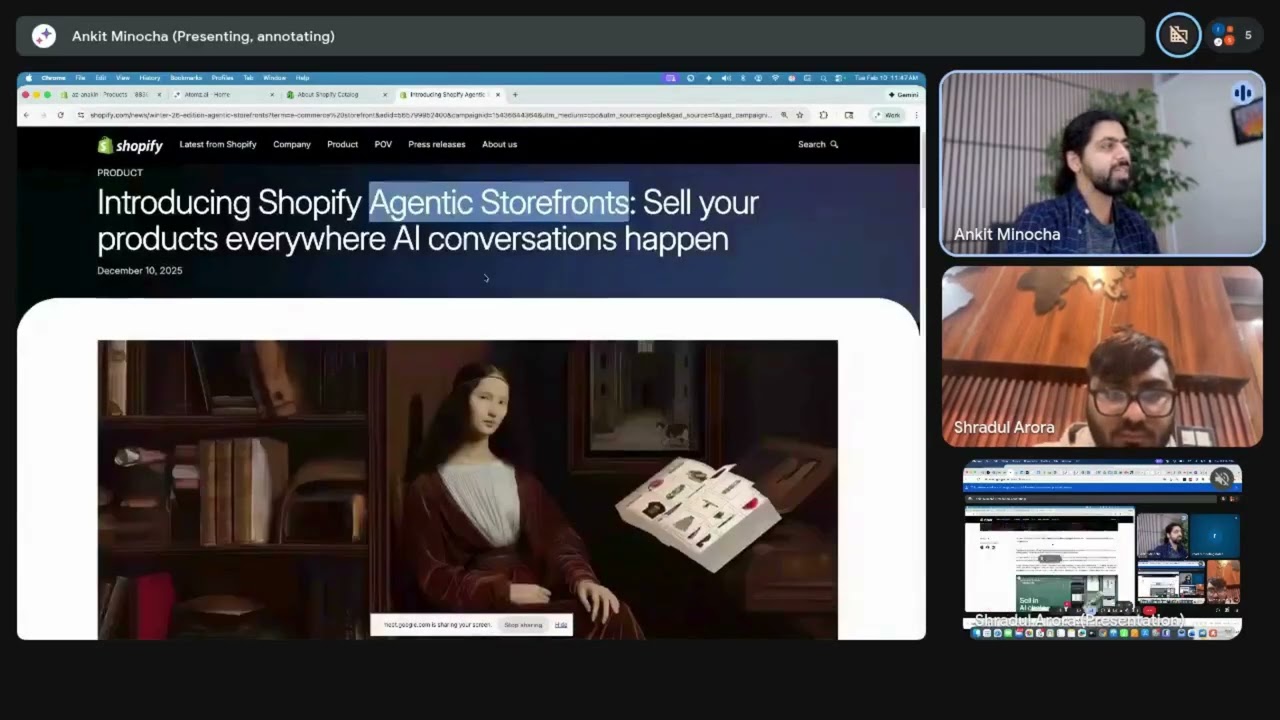
I recorded a walkthrough showing what this looks like inside Shopify admin. | |||
The organic window has a timer on it now. On February 9th, it started ticking. | |||
In 2005, the merchants who moved first never had to pay for what everyone else bought later. This is that moment again. | |||
See where your store stands → gpt.atomz.ai | |||
| |||
– Ankit |

If this was useful, the next one will be too.
Weekly. Free.
Unsubscribe with one click.
