Claude can now shop, and Shopify is a launch partner
and what that means for a merchant
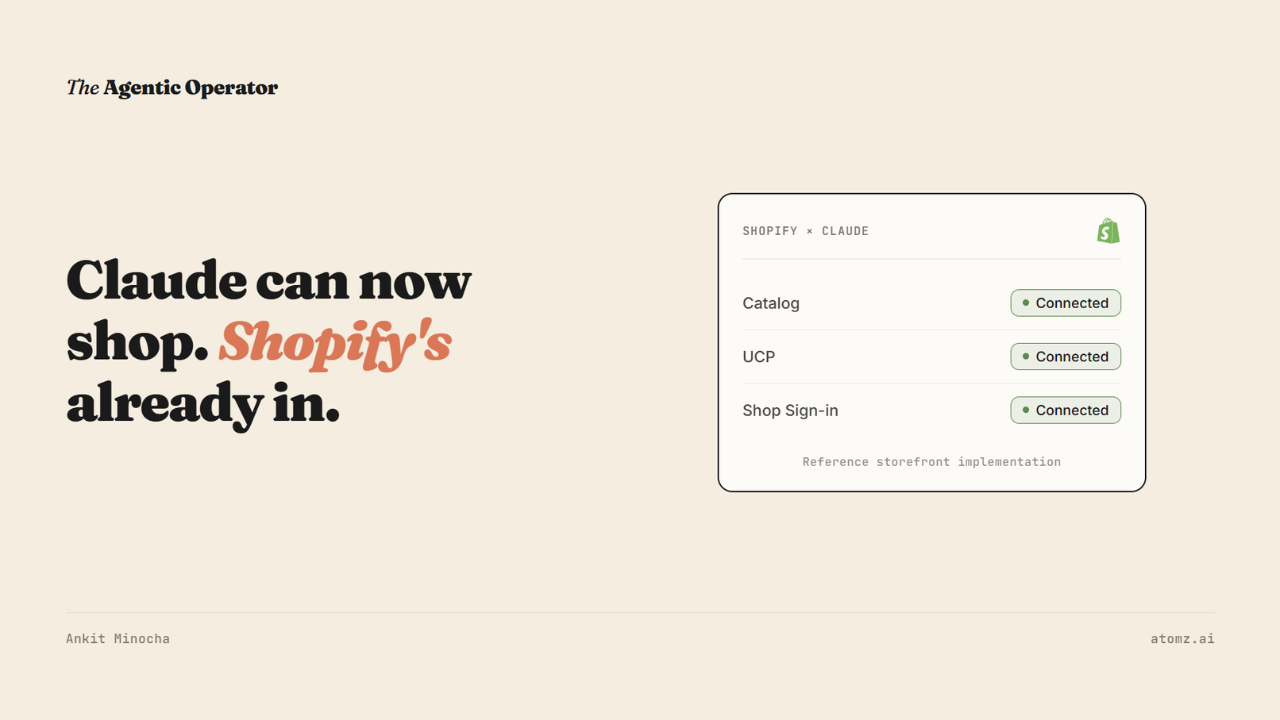
Anthropic announced last week that Claude can now shop.
They shipped an open, forkable blueprint. Any engineering team can pull it and have a working shopping agent running in days, not months.
It ships as two agents.
1/ One lives inside a store's app or site, built for shoppers. You can describe a multi-item need in one sentence, like camping gear for a family trip - and it searches the catalog, assembles a matching set, and hands the finished cart to checkout.
2/ The other is for running the store. You can ask what's worth marking down before last season's stock ties up shelf space, and it answers from the store's sales history, watches inventory for problems, and drafts pricing or campaign ideas.
It’s open source, built on Claude's Messages API, Agent SDK, or its managed agents.
Shopify is one among a few building on it, alongside Visa and Mastercard on the payments side. It's not just retail - travel, telecom, and ticketing are in scope too.
Where Shopify fits
This isn't new territory. Products are already discoverable across ChatGPT, Microsoft Copilot, and Google AI Mode. Claude is the latest one plugged in.
Vanessa Lee, Shopify's VP of Product, confirmed it directly. Shopify is building the connection itself, through Catalog, UCP, and Shop Sign-in.
1/ Catalog - the structured product data an agent reads instead of guessing.
2/ UCP - the protocol that lets an agent build a cart, complete checkout, and track an order without a custom integration for each store.
3/ Shop Sign-in - lets the agent recognize a shopper who's already logged in, with their saved details carried over.
That's the same structured layer Shopify already exposes to every AI agent.
What already exists on Shopify
We've been working on exactly this layer.
The Atomz AI Assistant is plug-and-play with your Shopify storefront, answering shopper questions straight from the store's catalog and content.
Ask about material, fit or a return window, and the AI answers from what's really stored on the product page, the blog posts and the uploaded docs.
Our goal is simple - every AI agent touching a Shopify store, whether it's for shopping, answering questions or checkout, should be reading the same clean data.
Ask Rothy's, Gemini-powered assistant
Google launched Business Agent in February, building on a simpler brand-profile Q&A feature. It adds a brand's own website on top of Merchant Center data, and lets a brand customize colors, welcome message and starter prompts.
So I noticed a button on Rothy's brand panel inside Google Search. It said Ask Rothy's.
When I clicked it, a chat opened right there inside the search results. It acts like a virtual associate for the brand and answers questions in the brand's voice.
It held context well across turns. I asked about loafers, then later just typed "anything in red" with nothing else attached, and it opened with "Since we were discussing loafers" and stayed in the category. It wrote as the brand, saying "we", and handled a question about a material Rothy's doesn't sell without getting strange about it.
Plus, every link in every answer was from Rothy’s website. There's no checkout inside the panel yet, so a shopper still lands on the website to buy.
What the panel exposed
I asked about one specific product, and the description came back raw. The semicolon delimiters from the feed were still sitting in the sentence, unremoved.
That's feed text reaching a shopper mid-decision as stored in Merchant Center.
There's no way to see this from outside the panel - no referrer or click to trace, or dashboard showing what Gemini said inside search results.
Does every brand need to fix this right now? Depends on how people are finding you.
Ask a chat like this something vague, and it hands back an answer regardless of the gap. Ask it something specific, and any hole in the data shows up immediately. The people typing questions into a brand's AI panel are usually the ones closest to buying.
Shopify's commerce agents are about to read straight through Catalog and UCP, the same way this one reads Merchant Center. That layer isn't optional anymore, whether the assistant reading it is Atomz's, Anthropic's, or Google's.
The Shopify catalog audit checks your catalog data, the discovery layer inside UCP. It shows exactly what an agent would see and how you rank.
- Ankit
If this was useful, the next one will be too.
Weekly. Free.
Unsubscribe with one click.
