The four ways brands show up in agentic commerce
Etsy, Sephora and Home Depot all play by different rules
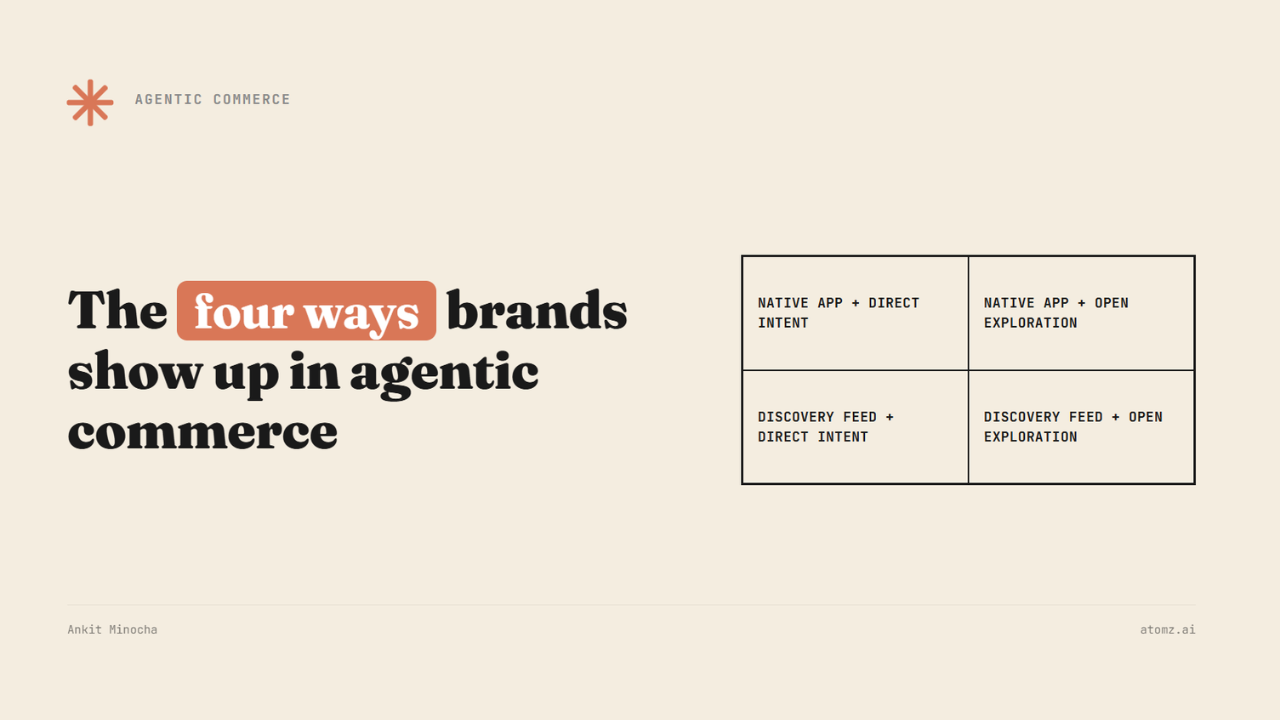
A shopper types "18V cordless drill under $200 with brushless motor" into ChatGPT. Another types "help me find a foundation for dry, sensitive skin".
Same app, two different paths to an answer. The drill query runs against a product feed and matches on structured data, while the foundation query can open inside a dedicated shopping experience that a brand built and maintains inside ChatGPT itself.
There are four ways a brand shows up in agentic commerce. Which one you get depends on how the shopper reaches you and what they're already asking.
I mapped this out on LinkedIn a few weeks back.
The four modes

Two things decide the quadrant:
How the shopper reaches you - a native app a brand built inside ChatGPT or the product feed ChatGPT reads without any brand involvement
What they're asking - a direct-intent query where they already know the spec or an open-exploration query where they're still narrowing down
Native app
1/ Native app, direct intent.
"Order me a bag of medium roast coffee beans".
Walmart, Target, Instacart, and DoorDash all run dedicated apps inside ChatGPT built for exactly this. It's the hardest quadrant on the map to build for.
What it takes: real-time inventory data, fulfilment commitments, and a custom app that OpenAI approves and connects with.
2/ Native app, open exploration.
"Help me find a foundation for dry, sensitive skin".
Sephora was first, launching its app in March. Etsy followed in early May, opening its 100 million-listing catalog to natural-language search.
ASOS came a few weeks after that with Stylist. Here's what it looks like.

All three stop short of the sale, narrowing down options before sending the shopper back to the brand's site to check out. The app changes how a shopper finds the product. It doesn't change what has to be true once they land on the page.
What it takes: the same custom app, plus a category claim strong enough that a shopper trusts a chat window over a search bar.
Walmart pulled its own numbers in March and found in-chat checkout converting at roughly a third the rate of walmart.com, so its app now routes shoppers into a Walmart-branded environment inside ChatGPT rather than closing a purchase in the chat itself.
Instacart is the cleaner example of quadrant one working as described: checkout genuinely completes without leaving the conversation.
None of that changes the cost of entry: a dedicated app, an approval process with OpenAI, and fulfilment or inventory systems that can answer in real time. Almost no Shopify brand has that, which is exactly why the next column matters more.
Discovery feed
3/ Discovery feed, direct intent.
"18V cordless drill under $200 with brushless motor".
Home Depot, Lowe's, and Best Buy show up here, no app and no approval process, just ChatGPT reading their product feed and matching on whichever fields are filled in. The brand with the most complete attribute data wins the match.
Miss wattage, motor type, or battery voltage as structured fields, and the query above never reaches you, no matter how good the product page copy is.
Here's what a fully structured product page looks like in practice.
4/ Discovery feed, open exploration.
"Gift ideas for a 7-year-old who loves dinosaurs, under $50".
Nordstrom and Wayfair live here. There is no exact spec to match, so ChatGPT reads descriptive metadata instead: occasion, use case, age range, theme.
A thin, generic description loses this query even for a genuinely good gift, because nothing in the data connects the product to "7-year-old" or "dinosaurs".

Where this leaves a Shopify brand
Every brand on Shopify already sits in the discovery feed column.
Shopify activated Agentic Storefronts by default for every eligible store.
Shopify Catalog already reads and syndicates your product data to ChatGPT's shopping surfaces. But which row you land in comes down to catalog data.
Direct-intent queries win with structured attributes: material, size, color set as a real variant option instead of buried in a title, the specs a shopper would type.
Open-exploration queries win with description depth: naming the occasion, the use case, the kind of person a product is for, on top of what it's made of.
Most catalogs are thin on both rows because descriptions get written for a human, not for either kind of question an agent is filtering on underneath it.
The Catalog audit we built already scores both levers on your store:
a) how complete your structured attributes are for a spec query
b) how deep your descriptions go for a browse query
Same two numbers this whole framework runs on.
- Ankit
If this was useful, the next one will be too.
Weekly. Free.
Unsubscribe with one click.
