Google Chrome started scoring your pages for AI agents
and what it means for merchants
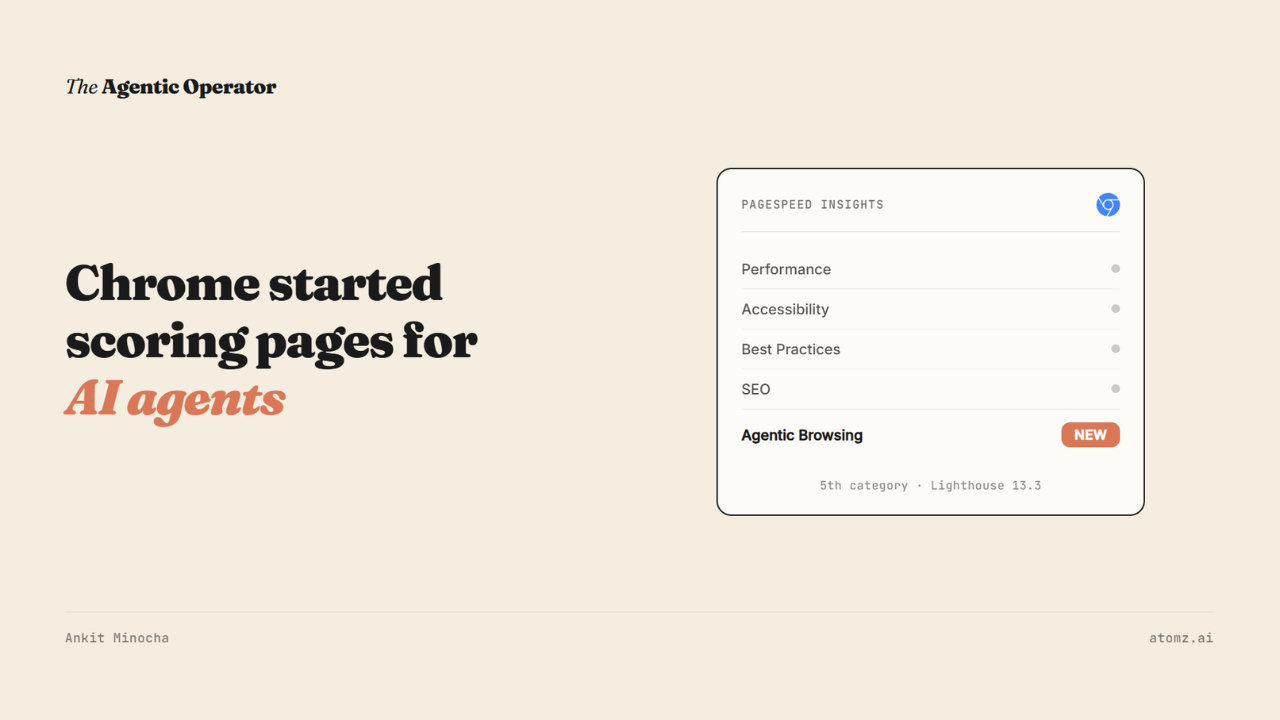
The traffic landing on a page today isn't always a person scrolling through it. It can be an AI agent acting on someone's behalf, trying to find something or make a purchase.
Lighthouse and PageSpeed Insights never had a way to measure that earlier.
The four scores were: Performance, Accessibility, Best Practices, SEO - built for a person looking at the page or a search crawler indexing it.
There's a fifth category sitting in that same panel now.

Source: PageSpeed Insights
Google calls it Agentic Browsing.
It measures whether an agent, one that's actually trying to click a button or fill in a form, can read the page and get something done on it.
What the four checks look for
Agentic Browsing doesn't score your page 0 to 100 the way Performance does.
Google says the standards for this are still forming, so instead of a ranking, you get a plain pass ratio: how many checks your page clears, out of the total.
Four things get checked:
1/ WebMCP - whether the page hands an agent a defined set of tools to use
2/ Accessibility tree - structural map a screen reader relies on (now read by agents)
3/ Layout stability - whether the page holds still long enough for an agent to act on it
4/ llms.txt - a plain-text file at the root of the site, written for an agent
WebMCP is the newest of the four. It's a standard that's still being finalized, so parts of it often come back informational rather than a clean pass or fail.
The accessibility check draws on work most sites have done for screen readers. Names on every button, labels on every field, nothing hidden from that map that an agent would need. If that's in place, this one usually comes free.
Layout stability reuses a metric from the Performance score. An agent locates a button, and if the page shifts before it clicks, it ends up hitting the wrong thing. Fixing it helps a human shopper too, not just an agent.
Chrome checks llms.txt in 2 parts: whether the file exists and whether it's any good.
A browsing agent and a shopping agent are not the same
It's easy to mix this in with everything else labeled "AI visibility".
Agentic Browsing scores what happens once an agent lands on your live page. It's trying to act on it directly, filling out a form or clicking through checkout.
So mostly, new infrastructure that Google is trying to build for the future of agentic.
And these agents are a different visitor from the one reading your Shopify Catalog data.
I went through how AI channels work with Shopify Catalog, and why one product shows up while a near-identical one doesn't, a few weeks back. Read it here →
That system never touches this new Lighthouse category at all. It reads a structured data feed. It never touches your page's accessibility tree.
So a store can score well here and still be invisible to a shopping agent deciding what to recommend. Run the free Shopify Catalog audit →
The one item Google's search team dismissed
This is the part that doesn't sit quite right. Google's own search guidance has said for over a year that llms.txt does close to nothing for Google Search.

Source: Chrome for developers
Chrome's new audit checks for that exact file anyway.
It's not really a contradiction once you separate the two systems. Search is saying the file won't move ranking. Chrome's team is telling you an agent landing on your page might use it as a shortcut to understanding what the page is about.
And both can be true.
The file just means something different depending on which part of Google is asking.
Where to go from here
This is not an emergency. Google itself calls it early and experimental.
Do try it once against the pages where an agent has something to do - your checkout, your cart, a product page - rather than your whole site.
A "not applicable" result usually just means the audit had nothing to check.
I ran it against a real product page (Glossier's Blush).
It came back 3 of 4. Layout stability passed clean at 0.024. WebMCP's schema check passed too, since nothing it found is broken.
So did llms.txt. Glossier already has one that clears the bar, on the exact file Google's search team waved off a few paragraphs up.

The one that failed was the accessibility tree. A collapsible ingredients panel and a promo carousel banner were structured in a way an agent can't parse cleanly.

The audit also flagged 9 forms on the page - search, add to cart, email signup, with no WebMCP annotations. That one isn't scored yet, but there’s a preview.
Layout stability is the one item worth fixing regardless.
The rest is closer to a watch list than a to-do list for now.
WebMCP is still finding its feet as a standard. Keep an eye on it, but there's no reason to build around it yet. llms.txt is very easy to add if you want to.
The actual readiness layer for a Shopify store to act on is the Shopify Catalog.
In this layer, the gap usually sits in whether your categories, attributes and product data are filled in and readable. Atomz fixes that layer directly, assigning categories and filling in the attributes that an AI shopping agent reads from.
- Ankit
If this was useful, the next one will be too.
Weekly. Free.
Unsubscribe with one click.
