How a shopper's AI query reaches your Shopify product page
ways to see what the queries are
AI Mode's query volume has more than doubled every quarter since launch, according to Google's own numbers from this year's I/O keynote.
Behind each question, an agent is usually running several more queries.
Say a shopper asks for a waterproof jacket for hiking, women's medium. The agent doesn't start searching with that sentence - it's more likely running three or four narrower passes behind it, like waterproof rating, hiking-specific cut, women's sizing and more. Then shows whichever products clear most of them.
None of that has ever been checkable by the merchant on the other end.
A few ways to see parts of it exist now.
What a fan-out query is
Google calls this query fan-out - one prompt splits into several narrower sub-queries, each checked separately, then merged into a single answer.
Each of those sub-queries functions like its own structured-data lookup.
A product with a strong description but a blank material field can clear three checks out of four and lose the fourth, with nothing that looks like an error anywhere.
Microsoft Clarity now shows some of them
Clarity's Citations dashboard has been live since May, tracking grounding queries (the sub-queries an AI system ran before it cited or skipped a page) and share of authority (how often a brand gets cited on a topic relative to competitors).

Source: Microsoft Clarity
Since last week, Clarity splits every query into branded and non-branded.
So you can see separately whether you're getting cited when someone searches your brand name directly versus a general category term.
It's free, though the data covers Microsoft's own AI surfaces and Bing-retrieval partners - not confirmed for ChatGPT, Gemini or Perplexity's own systems directly. Still the most direct free way to see this layer for the ecosystem it does cover.
Google's version covers different ground
Google already has two tools doing part of this. One scores attribute completeness inside Merchant Center, the other reports AI impressions inside Search Console.
Search Console still doesn't break any of it down by query.
Search engine reporters were still finding odd, conversational-sounding queries buried in the regular performance report this month. They ended up guessing which ones came from AI Mode because Search Console won't say so directly.
Clarity's grounding queries report is the one built specifically to show the sub-queries themselves. Google's tools are stronger on attribute completeness and funnel stage. Neither one goes this deep on individual queries.
The system that decides whether you're picked
Clarity and Search Console both work off the open web - what a page says, whether it gets cited in a written answer.
A shopper buying through a shopping agent runs on a separate system entirely. That agent reads the Shopify Catalog directly without touching your page's on-site content.
Shopify's own Agentic section shows how your products rank against queries right now. It decides whether a product enters an agent's shopping session at all.
What to check
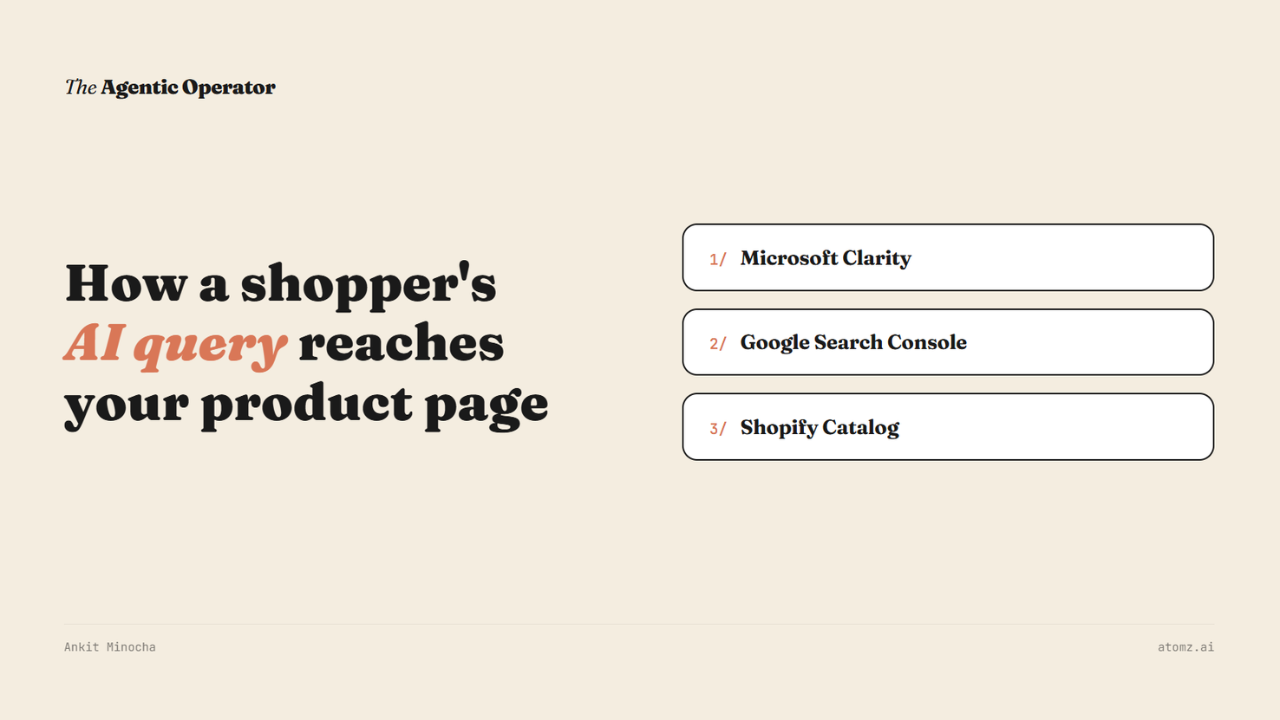
1/ Clarity's grounding queries report, under AI Visibility > Citations, for the sub-queries triggering or missing your pages.
2/ The Agentic section of Shopify admin, for the queries in your category and how your products rank today.
3/ The same Shopify Catalog API ranking, plus the full catalog data behind every result that outranked you - see what made the difference. Check it out here →
The first works off the open web - a page can get cited there and still lose every query inside a shopping agent's session, because that agent never looked at the page at all.
The second and third are two ways into the same system, Shopify Catalog.
All these tools together are the closest thing yet to seeing sub-queries.
At Atomz, we are also building a cleaner version of this for you to see and track how you are performing on a specific set of queries.
You’d soon be able to track which competitor’s product you’re outperforming and who outperforms you when the query hits the Shopify Catalog API.
On a side note, I built another tool to see whether the copy on your product page itself reads as AI-written since Claude announced watermarking.
- Ankit
If this was useful, the next one will be too.
Weekly. Free.
Unsubscribe with one click.
