How brands rank last in AI results
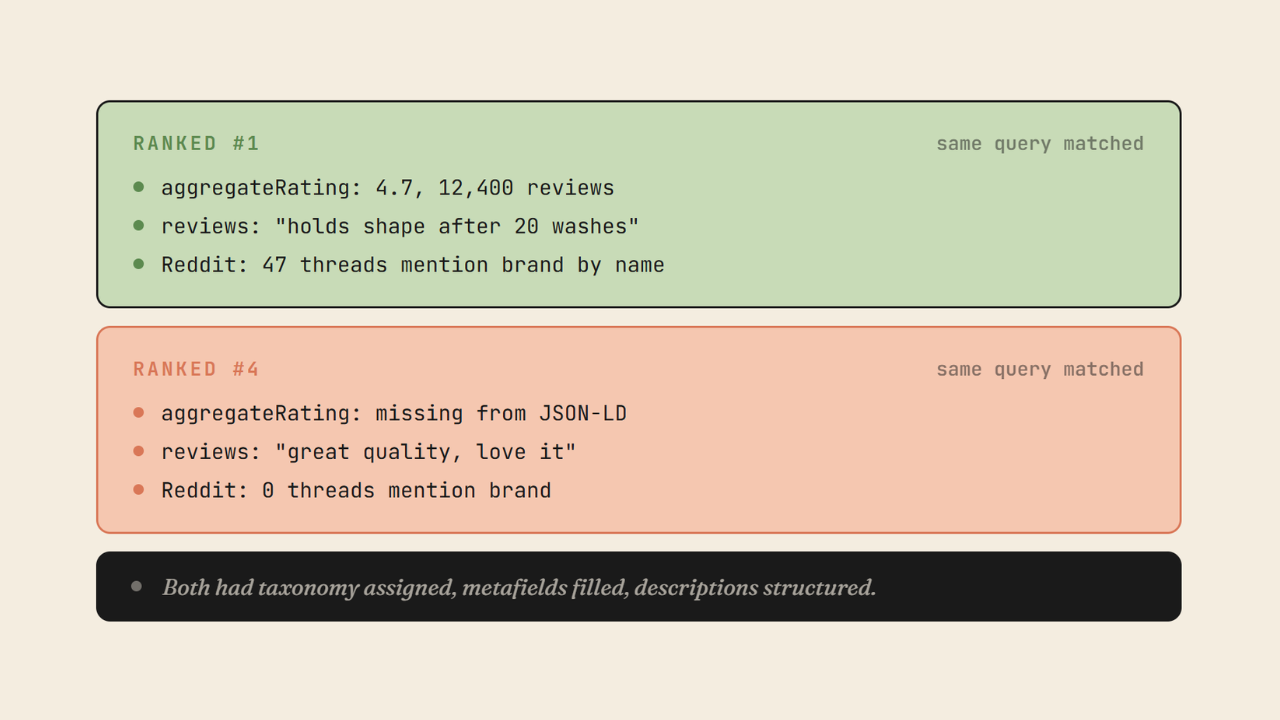
Once your product matches a query (buyer’s prompt) on ChatGPT/Gemini, the system ranks it against every other product that matched the same query.
That ranking decision relies on 3 external signals other than your catalog data:
→ the structured markup on the product page
→ the language customers use in review text
→ how your brand appears in the third-party content that AI actively reads when deciding which products to recommend.
OpenAI's shopping product lead, Adam Fry, described the mechanism here. He said ChatGPT is "trying to understand how people are reviewing this, how people are talking about this, what the pros and cons are." The system explicitly pulls from editorial commerce reviews and forums including Reddit.
That covers three distinct signals, and each one has a specific thing you can check.
Signal 1 - Review schema
When an AI crawler reads your product page, it looks for structured data in a block called JSON-LD. Inside that block, the review data should appear as an aggregateRating field containing a ratingValue and a ratingCount - not the stars on your review widget, but a machine-readable field in the page's code that the system can parse as a ranking signal.
Most review apps inject this schema via JavaScript after the page loads, and some do not inject it at all. Yotpo's free plan outputs on-page review widgets with no JSON-LD schema, meaning a product page with thousands of reviews has zero structured rating data for an AI crawler to parse. Judge.me includes the schema on all plans, including free. Loox outputs it reliably on most themes but requires a manual snippet on older Dawn builds.
There is also a conflict problem: if your theme and review app both output a Product schema block, an AI crawler may encounter conflicting data and fall back on neither.

Check yours - go to search.google.com/test/rich-results, paste your product URL, and look under Detected Items for a Product block. Inside it, look for aggregateRating with a ratingValue and a ratingCount. If it is there, AI crawlers that render JavaScript can read your review data as structured information. If it is not there, they cannot. The test takes 60 seconds and requires no account or signup.
Signal 2 - Review language
The aggregateRating tells the system your score. The review text tells it what people actually say about the product, and that language is what the system uses to rank your product for queries that go beyond category and attribute matching.
The r/SkincareAddiction post "Rating every Moisturizer tried 24+" has 6,300 upvotes and 548 comments. The brands that appear in AI recommendations (CeraVe, Vanicream, La Roche-Posay) are the same brands discussed in that thread using specific attributes - fragrance-free, non-comedogenic, barrier repair, suitable for sensitive skin.

6,300+ discussing moisturisers using the exact attribute language AI agents rank by.
A product with 400 reviews, where every customer wrote "great quality, love it, fast shipping" gives the system almost nothing to differentiate it from a generic competitor.
A product where customers write "holds shape after 20 washes," "no synthetic fragrance smell," "fits 4E wide width without creasing" gives the system attribute-dense language it can use to rank that product for queries that include those specific terms.
The ChatGPT comparison table below shows how that language becomes structured columns in a product recommendation - fragrance-free, barrier repair, texture - pulled directly from what people say about these products across the web.

ChatGPT turns reviews into structured attribute columns used to rank matched products.
Extract your attributes - Paste your 20 to 30 most recent reviews from a product you want agents to discover into Claude and ask: "Extract the 10 most-cited product-specific attributes from these reviews. List them as structured terms".
Then check whether those terms appear as filled metafields. The gap between what your customers say and what is in your structured data is your Signal 2 problem.
Signal 3 - Third-party footprint
The third signal is how your brand appears in content beyond your own store.
When you type "Nike shoes site:reddit.com" into ChatGPT, the response synthesises threads from r/Nike and related communities, cites them inline with source badges, and surfaces the repeated attribute terms from those threads - cushioning, durability, stability.
AI reads what people say about a brand across such forums, and it is exactly what it uses to rank products against each other once both have already matched the same query.
A brand discussed in a "best fragrance-free moisturiser for sensitive skin" editorial roundup, a Reddit thread with hundreds of upvotes, or a niche review site that uses specific attribute language has a third-party signal that the product page alone cannot generate. A brand with clean catalog data and no third-party footprint probably ranks below a brand with slightly thinner structured data, but an established presence in the conversations people have about that category.
Audit your footprint - run both of these in ChatGPT or Gemini (not Claude, as web search results render differently across tools):
[brand name] [product category] site:reddit.com
best [product category] 2026
Count how many results name your brand. Read the attribute language in those results. If your brand does not appear in either search for your category, your third-party footprint is empty at the query level where the ranking happens.

ChatGPT synthesising Reddit threads and surfacing the attribute terms that determine rank
This is not a fast fix but auditing where you stand costs five minutes.
Where this leaves you
Signal 1 takes 60 seconds to check, Signal 2 takes 10 minutes, and Signal 3 takes five minutes. None of them requires a tool. Layers 1 and 2 - taxonomy, metafields, description structure - are what the free catalog audit covers.
Enrichment Process at Scale with AI
Catalog Genius reads your catalog to find agent discovery gaps, then assigns the correct Product Taxonomy category to each product and enriches the metafields.
Install Catalog Genius on Shopify - first 20 products free
- Ankit
If this was useful, the next one will be too.
Weekly. Free.
Unsubscribe with one click.
