Meta is now an AI channel in your Shopify admin
your catalog is already live on Muse
Meta launched Muse on September 8. It's a personal AI agent that does tasks for you, and shopping is one of them.
Muse is Facebook's version of ChatGPT. And like Google, they hold a lot of our data.
A week after launch, it was the No. 1 free app on Apple's US App Store, ahead of ChatGPT.
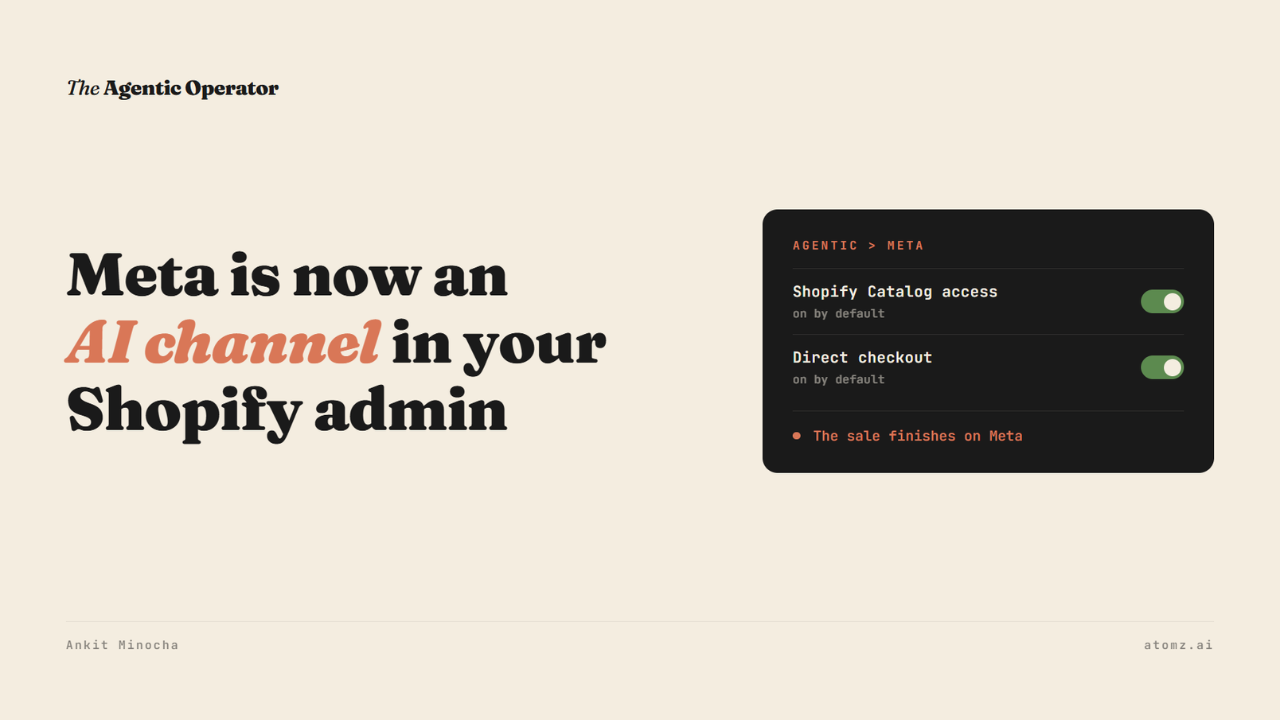
The same day Muse launched, Meta showed up as a new AI channel in Shopify admin. Your products are shared with Meta by default through Shopify Catalog.
Two days back, Shopify's CEO Tobi Lütke announced a partnership with Muse to enable agentic checkout with Shop Pay on all Shopify stores.
A day before that, Amazon had blocked Muse from shopping on its site.
Amazon shut Muse out, and Shopify opened every store on its platform to it.

What changed in your admin
Meta now sits next to ChatGPT, Microsoft Copilot and Google AI Mode in Agentic Storefronts. It comes with two settings:
Shopify Catalog access - whether Meta can read your products
Direct checkout - whether a shopper can buy without leaving Meta
Both are on by default for eligible stores. To change either one, go to Sales channels > Agentic, turn off "Allow Shopify to manage for me," and click Meta.
Direct checkout is limited to shoppers in the US, Canada and Mexico.
Why Meta could win on recommendations
My guess is Meta will win it big on personalized product recommendations. That's because query formation seems to be different here.
On ChatGPT, a person types what they want. On Instagram and Facebook, Meta already knows what they looked at, saved and lingered on.

Source: Meta
The intent is implicit, and the recommendations can be so much better.
Muse can turn a recipe reel someone saved on Instagram into a grocery list. It also remembers details a person mentioned once and suggests things without being asked.
Where the sale finishes
On ChatGPT, the buyer lands on your website checkout. On Meta surfaces, with direct checkout on, they never come to your site at all.
That changes a few things on your side.
Orders show up in your Shopify admin, attributed to Meta. You stay the merchant of record, so fulfillment, returns and customer service are still yours.
Your browser pixels won't see these sales. Google Analytics and custom pixels don't fire in Meta's direct checkout. The checkout sends just two server-side events, checkout started and checkout completed.
Some products can't be bought there yet. That includes subscriptions, bundles, customizable products and B2B-only items.
Someone building for subscription commerce flagged this in the comments on my post. My guess is subscriptions come soon, because Meta owns the checkout.
The catalog record makes the call
This puts the whole decision on the catalog record. There's no product page in the path to map intent to products. It's all about the attributes.
Shopify's doc for the Meta channel says product discovery there is powered by Shopify Catalog. It also asks you to put any legal disclosures in the first 6,000 characters of your description.
Across a sample of 400,000+ live Shopify products, we found 51% of what a shopper asks about sits somewhere in readable text. Only 6% of that is filterable.
Implicit intent leans on fields even harder.
Say Meta knows a shopper keeps saving linen shirts. If linen sits in your description and nowhere else, there's no material field for that match to land on.
Four things to check this week
1/ Open Sales channels > Agentic > Meta and look at both settings. They're on unless someone changed them.
2/ List any subscriptions, bundles or customizable products you sell. Those can't go through Meta's direct checkout yet.
3/ Tell whoever reads your ad and analytics reports that Meta checkout orders won't show up in pixels. The orders attributed to Meta in your admin are the place to look.
4/ Move colour, size and material out of titles and tags, into real options and fields.
The audit shows what an agent reads from your catalog, and how you compare with competitors for the same shopper queries.
- Ankit
If this was useful, the next one will be too.
Weekly. Free.
Unsubscribe with one click.
