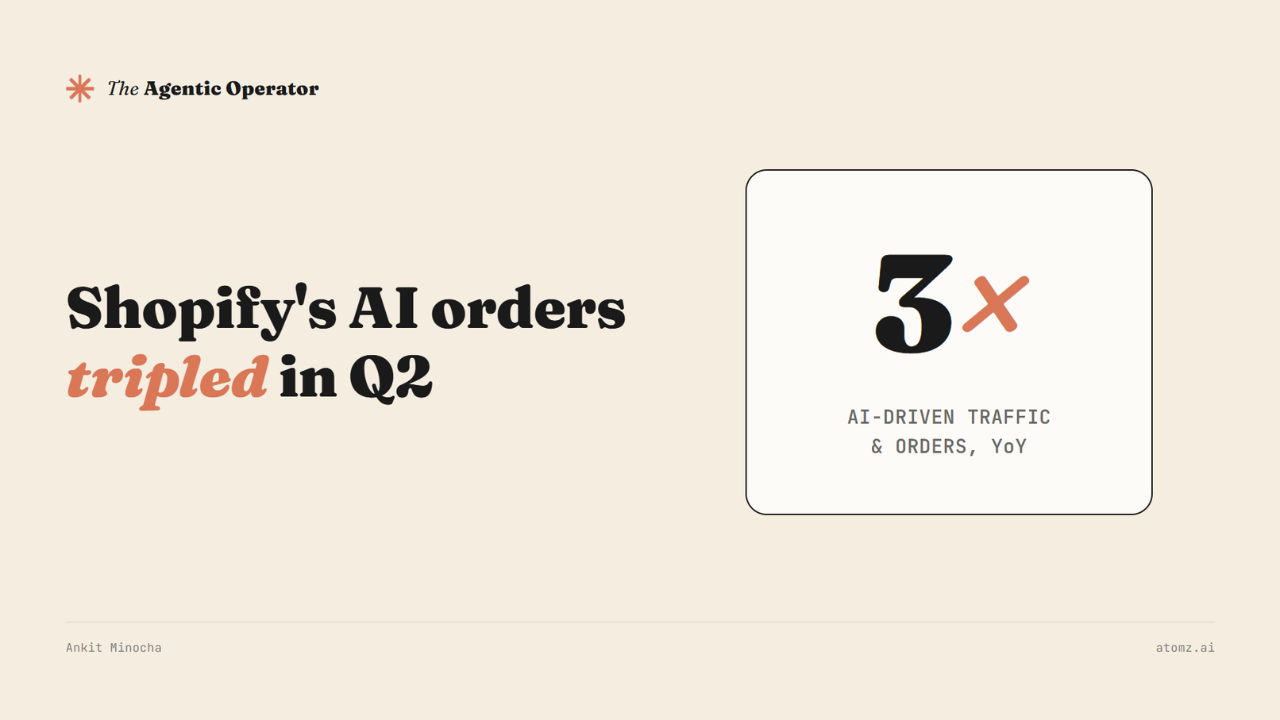
Shopify's AI orders tripled
75% of those orders went to products outside Shopify's top 100 categories and the same pattern showed up everywhere else
Shopify reported their second quarter earnings call last week.
Revenue up 34% to $3.58 billion, GMV up 32% to $116 billion, net income at $1.5 billion, up from $906 million a year ago. Fifth straight quarter with over 30% growth on every major line. The stock jumped more than 17% the same day last week.
What I loved was that Harley Finkelstein (President, Shopify) walked through what's actually driving it - Agentic Commerce and here are some numbers:
AI-driven traffic and orders both 3x year over year
Products found through Shopify Catalog converted at roughly twice the rate of products found through scraped, unstructured pages
AI-referred shoppers landed directly on a product page 2.5x more often than shoppers coming through normal search
New buyer orders from AI channels came in at nearly 2x that of other channels
75% of those AI-attributed purchases came from outside Shopify's top 100 product categories
He shared these examples: "A harness for a French Bulldog. A car seat that sits three across in a sedan. A screenless phone for kids" - real products on Shopify benefiting from AI search. These are small, oddly specific products an AI agent can find.
Why is this happening
Here's the mechanical reason behind the 2x conversion for products found through Shopify Catalog and structured product pages.
Shopify Catalog is a structured database the company has spent close to two years building - over a billion products, organized so an AI agent can read the category, material, and size as structured fields instead of guessing from on-page copy.
When an agent can trust the data, it can match a buyer's exact question to the exact product. A French Bulldog harness or a screenless phone for a kid would rarely rank against a thousand more popular items on a normal search page.
For an agent, the fact that the data is there is what matters.

Structured category metafields inside Shopify Admin
A store where the product sits behind vague copy doesn't get that match. The agent has to guess, and guessing is where good products stay invisible.
This is also why AI-referred shoppers land on a product page directly 2.5 times more than shoppers coming through normal search.
By the time someone arrives that way, they already know what they're looking for, because the AI matched the question to the product before they ever saw a homepage. There's no browsing phase left for the page to work with. It has to sell the product and answer the question at the same time - on the first look.
This shows up everywhere else too
Shopify built two products this quarter that both bet on the same idea, and so did the rest of the industry, in very different ways.
On Shopify's side - Sidekick, the AI assistant built into the merchant admin - had a matching jump. Daily active usage increased 3.6 times, sessions rose 4.8 times, and it handled nearly 34 million merchant conversations in the quarter.
Merchants are using it to build small tools like a returns eligibility checker and a bulk importer for B2B customers. Across the platform, merchants built more than 36,000 of these tools, up from 12,000 the quarter before.
Whether or not you ever open Sidekick, what matters is that Shopify spent this year building for a world where an agent handles the shopping and an agent handles running the store, on both ends of the same transaction.
The rest of retail is sorting into a similar split, with different winners on each side.
Sensor Tower's most recent report (State of AI 2026) found Walmart and Target, both partnered with ChatGPT, pulling in more than 1.5% of their traffic from generative AI referrals. Amazon sits at roughly 0.5%.

This is because Amazon has largely blocked ChatGPT's crawlers from its catalog and is reportedly suing Perplexity over its shopping agent's activity on its site. That protects Amazon's ad business and its grip on the buyer relationship.
It's a tradeoff Amazon is making on purpose and still gets an upside through its own AI assistant, Rufus, where users convert at close to 2x the rate of people who skip it.
Amazon and Walmart made opposite bets, but the same pattern explains both results - an AI layer that understands what someone wants outperforms one that doesn't, whether that layer belongs to the platform itself or to an external agent reading the data layer.
What are we solving
At Atomz, we are building the data layer that both your internal AI tools and external agents need. Whether it’s your on-site AI search or shopping assistant or channels like ChatGPT and Google AI Mode, all expect your catalog to have structured data.
For your brand to show up in any of the AI layers, an AI agent needs to read your product data - worth checking where your brand’s catalog stands.
- Ankit
If this was useful, the next one will be too.
Weekly. Free.
Unsubscribe with one click.
