Shopify brands are serving AI agents the same file
8 of 11 brands
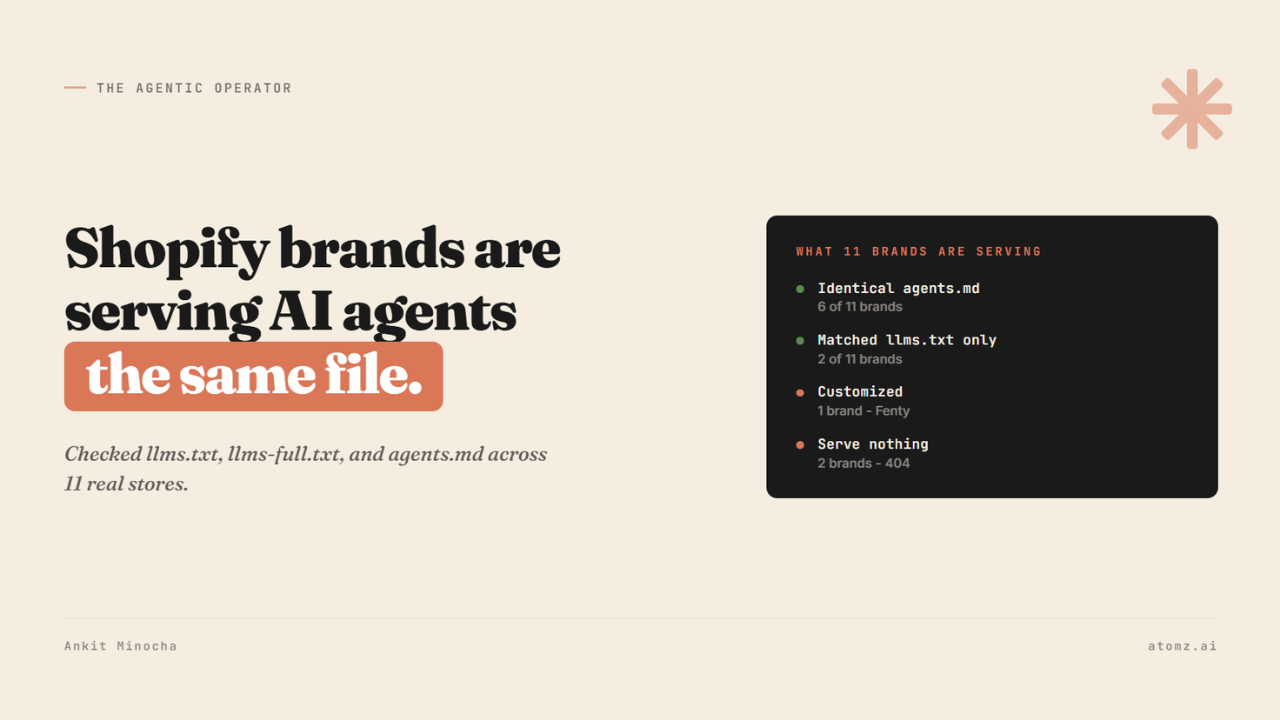
I checked llms.txt, llms-full.txt, and agents.md across 11 real Shopify brands - Fenty, Gymshark, Rothy's, SKIMS, and others. Every eligible Shopify store auto-serves these three files today. Almost nobody's looked at what's actually in theirs.
What these three files actually are
agents.md is canonical - the operating manual an agent reads to search, cart, and check out through Shopify's Universal Commerce Protocol.
llms.txt is a shorter description meant for a language model to read.
llms-full.txt exists mostly to mirror agents.md and llms.txt. Shopify's own guidance says most stores don't need a separate template for it - maintaining three files instead of one isn't worth it unless you have a specific reason.
In concept, these are three different things. On Shopify, unless someone's gone in and customized them, that distinction doesn't exist. They're the same file at three URLs.
Why agents.md matters and llms.txt doesn't
Google's own May 2026 guidance tells site owners they don't need llms.txt necessarily for AI search. A SERanking study of roughly 300,000 domains found no measurable citation lift from publishing one. Major AI crawlers barely fetch it.
agents.md is different. It isn't about getting cited - it's about whether an agent can actually transact on your store through UCP - cart, checkout, the whole flow.
So "did they customize it" was the wrong first question going in. The better one: did they customize the file that's actually wired to checkout, or just the one that describes them.
Nine brands, the same file content
Fenty Beauty, True Classic, Rothy's, Brooklinen, Allbirds, Kylie Cosmetics, Kith, ColourPop, and Steve Madden - 9 of the 11 brands checked came back identical on llms.txt and llms-full.txt - same phrasing, same six-step agent flow and same UCP version numbers.

Source: True Classic’s llms-full.txt
Rothy's file even carries the auto-generated typo "interact with Rothy's's online store" - what a template produces when it appends 's to a name that already ends in one.
Two of these already have our Catalog audit history: Allbirds scored 75/100, Kylie Cosmetics scored 9/100, back in June. Nothing about that gap shows up here. A well-structured catalog and a completely untouched agent file coexist just fine.
One exception: Fenty's agents.md - the file actually wired to checkout - is a real, organized index running past 200 URLs, sorted by page type and product line.

Source: Fenty Beauty’s agents.md
Fenty is the one brand in this sample that invested in the file that actually matters. But its llms.txt and llms-full.txt are both still stock default - including boilerplate text claiming to mirror agents.md that doesn't actually reflect any of what Fenty built. Customizing the right file doesn't help if the fallback to the other two doesn't carry it through.
When the biggest brands have nothing there at all
Nine had something serving, even if it was the same something. The other two don't.
Gymshark and SKIMS don't serve any of the three files. Not the default, nothing - every route returns a 404, confirmed twice each.

Both run Shopify Hydrogen, a headless setup that swaps Shopify's standard theme layer for a custom-built React storefront. That's the most likely explanation: these files generate off the Liquid theme layer, which Hydrogen storefronts don't use. A dev team would need to build the route by hand for it to exist at all.
Two of the most technically resourced brands in this sample are missing a file that costs nothing to add on a standard store.
Where to start
Check it yourself first:
yourstore.com/agents.md
yourstore.com/llms.txt
yourstore.com/llms-full.txt
Run the free audit - checks all 3: served or not, default or customized

Check yours here →
On standard Shopify: don't delete the default. Keep the UCP and agent-discovery links, then replace the generic brand description and the "start your own Shopify store" footer with what actually makes you different from every other store running the same file.
On Hydrogen or any headless setup: not as a toggle - it's a route someone has to build. Put it on the list for whoever owns your storefront code.
This isn't a metafield problem - the fix here is a template, not a product field.
But agents.md only introduces your store. What an agent actually finds once it's inside - thin descriptions, unstructured attributes - is a different problem, and it's still sitting there even after the file is fixed. That's the part Atomz structures.
- Ankit
If this was useful, the next one will be too.
Weekly. Free.
Unsubscribe with one click.
