Shopify can only filter on 26% of what AI shoppers search for
what that means for your product copy
Whatever's missing from your product data, write it in, and an agent can read it.
That's still true. But it only closes part of the gap. I wanted to know how much of what a shopper actually types could even become a field to fill in.
So I pulled the real searches shoppers type into Amazon's autocomplete and checked each one against Shopify's taxonomy - 7,144 of them across 75 subcategories.
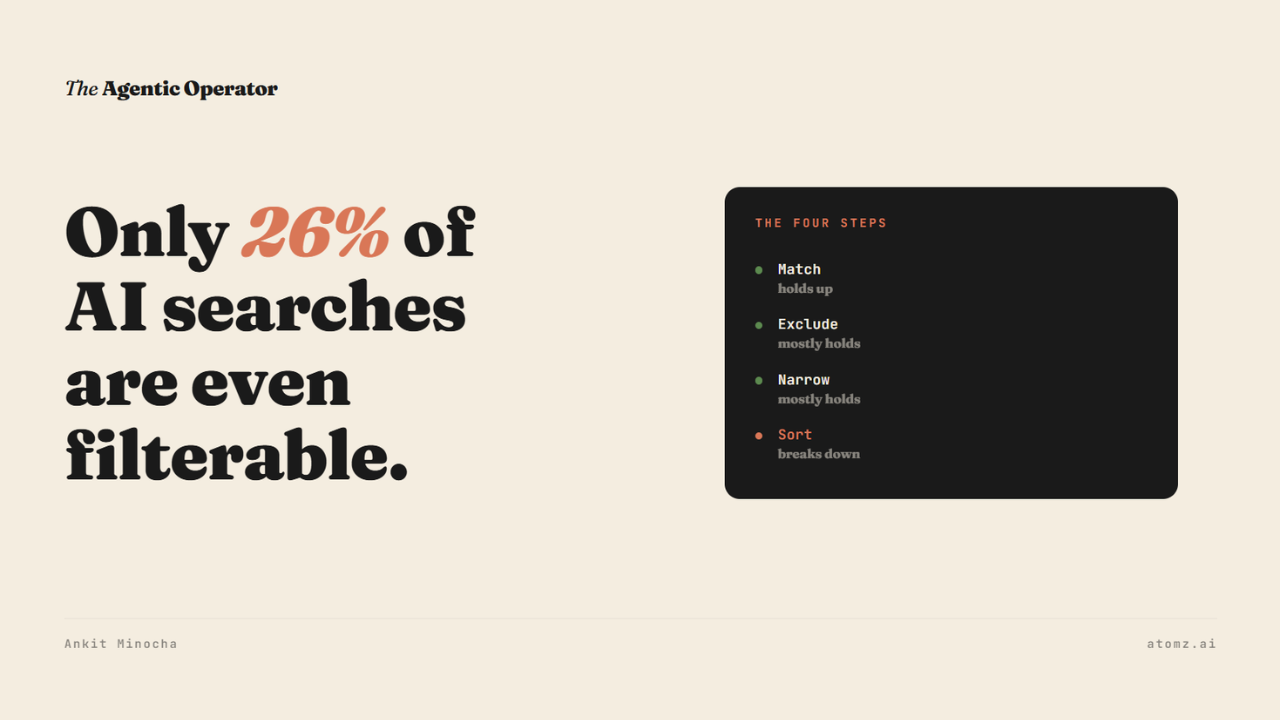
Only 26% of the highest-demand searches in each subcategory landed on something Shopify tracks as an attribute. Other 74% was audience, brand, style and all the specific extra words a shopper adds to their search term. The kind of detail that can live in product copy, no matter how thorough your metafields are.
That's a different number from the research report we recently published. That report checked whether products have their data filled in and structured.
In this one, I tried to check whether the word a shopper types has anywhere to go at all.
Most of it isn't even filterable
Take "cowboy" out of "cowboy boots for women".
Take "with pockets" out of "cotton leggings with pockets".
Those are the words doing the real work in each search and none of them can be in a structured field in Shopify's taxonomy. A shopper will type them anyway, because that's how they think about what they want.
Even inside that 26%, mapping to a field doesn't guarantee much. 48% of those land on one the catalog misses more than half the time. And across all 75 subcategories, the #1 thing shoppers search for is a Shopify attribute in only 21 of them.
So filling in the empty fields helps. It will not close the whole gap on its own.
What should filter doesn't always
I also live-tested 663 real searches that ask for something specific, a colour, a size, a material, a style, through the Shopify Catalog API.
For each one I checked how many of the top 25 results actually matched it.
The average across every category: 76%.
Jewellery came out highest, at 91%. Health & wellness came out lowest, at 51%.
Examples of some individual searches that did far worse than either:
"pet carrier purse 20 inch": 0% matched
"ridge power bank blue": 4% matched
"compression leggings for women plus size": 4% matched
For 19% of the 663, fewer than half the top 25 results matched.
What ranking has to cover
Let’s put both findings together - most of what a shopper asks for was never going to be a filter. And a share of what should filter correctly doesn't.
That's the same conclusion the Catalog Visibility Report reaches from a different angle. So it splits shopping into four steps: match, exclude, narrow, sort.
The first three (match, exclude and narrow) are all filtering in different forms and they mostly work. Sort - the fourth one is ranking, it's where the process breaks down. Ranking runs on whichever listing reads closest to the words in the query, because there's rarely anything else to check it against. Read the report →
What's in your control
There's no setting to turn "cowboy" or "with pockets" or "plus size" into a filter. Those words can only be matched through plain text on the product page.
Which means copy is the only thing that captures what shoppers type, and it has to use their words: cowboy, with pockets, plus size.

Run the audit - and see how many of the words shoppers search with are sitting anywhere in your product text right now.
- Ankit
If this was useful, the next one will be too.
Weekly. Free.
Unsubscribe with one click.
