Shopify products score 51 out of 100 on what AI agents can read
on average what an AI agent can read
When a shopper asks ChatGPT for a "wedding dress".
The AI shopping agent takes the prompt, breaks it into multiple queries, and looks for it in various sources. For Shopify merchants, that is the Catalog API.
A gown that comes in size XXL sits mid-list, a few results down.
Add "xxl" to the search, and that same gown drops lower instead of rising.
A different dress jumps up ahead of it, one whose title happens to include the word "XXL" whether or not XXL is a size it offers.
What the shopper wanted is sitting right there in the first gown's product data, ready to filter by. The agent just doesn't use it that way.
AI matches "xxl" as a word in the text, not as a size to check against, so a listing that only mentions the word can beat a listing that has it.
That's a pattern from a report we just put together: Shopify Catalog Visibility Report.
We checked the live Shopify catalog the same way an AI agent reads it. Every product on Shopify holds some information. And an agent can only use some of it.
Filterable: an option built into the product, like a size or color dropdown, gives an agent something to pick from directly.
Readable: sitting in the title or description as plain text. An agent can find it and match the words, but can't filter by it the same way.
Missing: not stated anywhere. The agent has no way to know.
The wedding dress is a readable problem. XXL is sitting in the product data as a filterable option. The agent's ranking doesn't use it that way.
The average score
We wanted to know how much of a typical Shopify catalog can be read by agents.
So we used an independent sample of the Catalog API, the same way an agent reads it - over 400k products from 26,000+ brands, across twelve categories.
This isn't a test on every Shopify store but a broad, product-weighted sample across different categories - big enough to find patterns and average numbers.
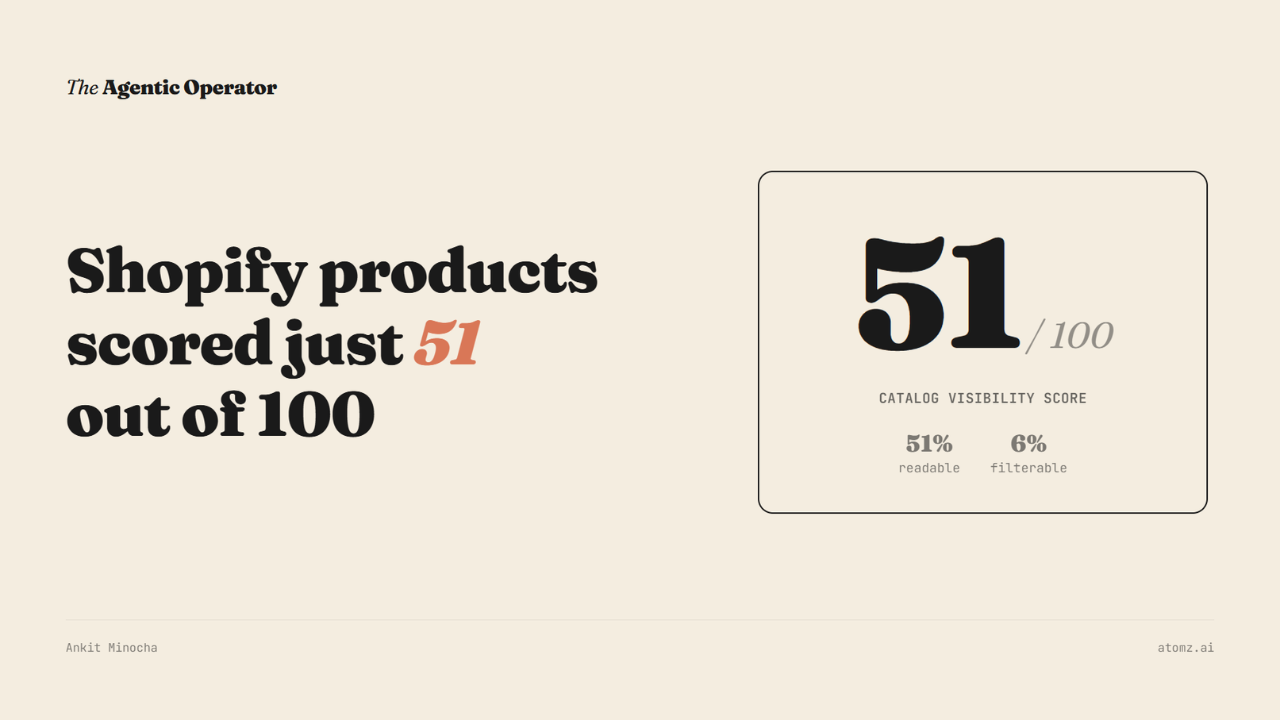
51 percent of what a shopper asks about is in text an agent can read.
Only 6 percent of that is currently filterable.

Source: The Catalog Visibility Report
The other 49 percent isn't stated anywhere.
The gap isn't random.
Only a handful of fields are real, selectable options for most products. Everything else - fit, occasion, what a product is for - is plain text, if it gets written at all.
An agent might still read that text. It just can't filter by it the way it filters an option.
Where categories land
The average of 51 we got covers a wide range.
Jewellery scores highest, at 67. Electronics scores lowest, at 34 - a laptop listing can leave an agent blind to the processor, memory, and operating system.

Source: The Catalog Visibility Report
All 12 categories were measured the same way.
And all land well short of what a shopper asks about.
The 49 percent that's missing is the part a merchant can fix right away: fit, occasion, whatever a shopper in that category decides on before buying.
The 6 percent that's filterable is Shopify's to grow.
This report is the first piece of a bigger project. The team's going to keep testing more categories and more shopper queries, and we'll keep bringing back what we find.
To see where your category lands and what its biggest gap is:
Find your score - this runs the same check against your live catalog and shows you exactly which facts an agent can already see, and which ones it can't.
- Ankit
If this was useful, the next one will be too.
Weekly. Free.
Unsubscribe with one click.
