AI holiday traffic to online stores is set to more than double
and where it lands on your store
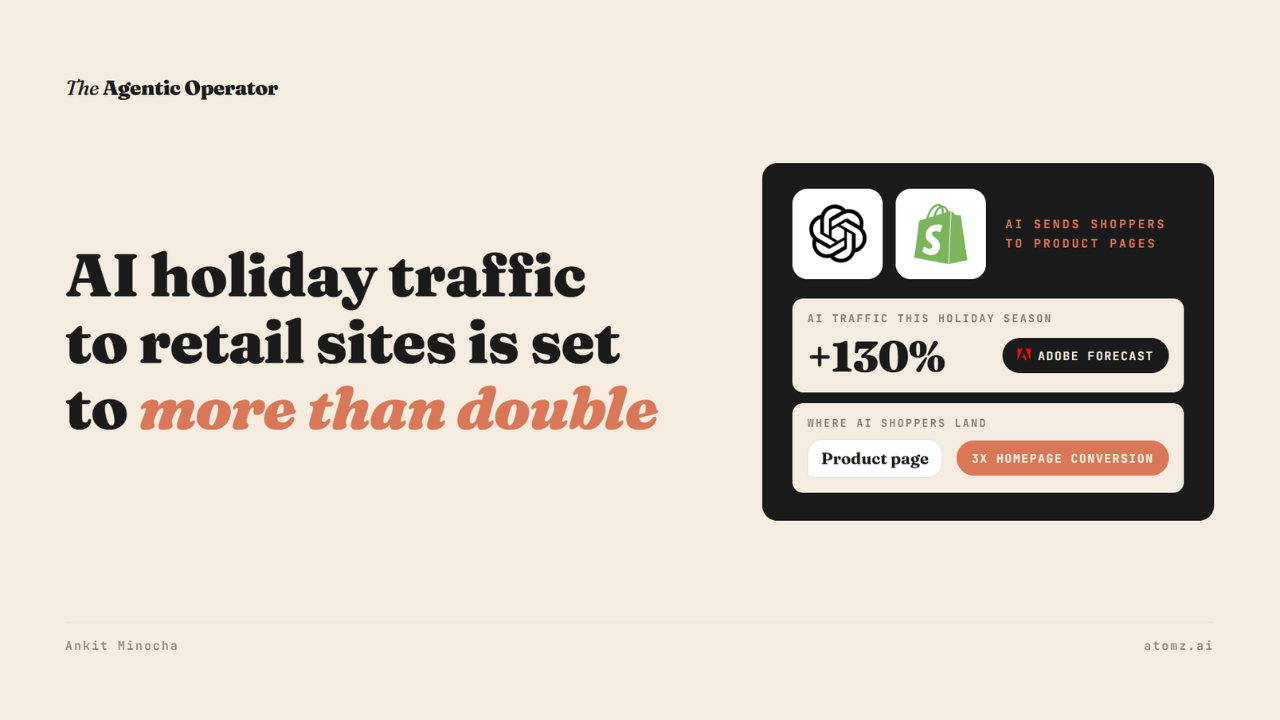
Adobe expects traffic from AI tools to US retail sites to grow 130% this holiday season.
That covers November 1 to December 31. It counts shoppers who click a link in an AI chat or browser and land on a store. The biggest jump is expected on Thanksgiving.
Overall online holiday sales are expected to grow 6.7%. AI traffic was already up 127% year over year in August.

Source: Adobe
A couple of months back, I shared Shopify's own numbers from its earnings call. AI traffic and AI orders on Shopify had both tripled in a year.
130% growth starts from a small base.
Two recent studies by two independent agencies show how small. One found AI assistants brought 0.21% of sessions this year across 73 online stores. The other put it at 0.10% across 10 established Shopify stores.
In the 73-store study, daily AI visits barely moved between last September and this one. But orders from those visits went from 5.9 a day to 16.1.
Why these shoppers buy
Adobe sees AI visits turning into sales across US retail too. In August, AI visitors beat other visitors on three counts.
Converted at a 48% higher rate
Added to cart 32% more often
Brought in 43% more revenue per visit
A year earlier, other traffic was out-converting AI traffic. Adobe's read is that these shoppers know what they want when they arrive.
I asked ChatGPT for a pour over coffee set under $60, as a holiday gift. It answered with three product cards, each with a price and a shop link.
All three links went straight to a product page. Two of the three stores run on Shopify.

Source: ChatGPT
The 73-store data backs this up. Half of AI visits across those stores started on a product page. Those visits converted at 1.77%, against 0.57% for AI visits that started on the homepage.
That product page has to answer what the shopper asked the AI, like fit, materials, stock or delivery time. The Hario page ChatGPT linked to lists the capacity, materials and what's in the box in plain text.
But for most Shopify stores, what a typical shopper asks about isn't in a field yet.
The Shopify Catalog audit shows what an AI agent reads from your catalog and how you compare with competitors for the same shopper queries.
Where to see it in Shopify
Shopify's Agentic section shows sales, orders, online store sessions and online store conversion for each AI channel. It sits under Sales channels > Agentic and includes the Shop app. Headless stores don't get this view yet.

Source: Shopify Help Center
Two things to know before you read the numbers.
Shopify changed how it counts sessions on September 21. Bots are now filtered out by default, so conversion rate can move even if orders didn't. Shopify says to treat that date as a new baseline.
Some AI traffic never shows as AI. Taps on a link in the ChatGPT app often arrive with no referrer and land in Direct.
Four checks before Black Friday
1/ Open Sales channels > Agentic and switch the view to Online store conversion. Start the date range after September 21, then compare each AI channel with your store's overall rate.
2/ In Analytics > Reports, open Sessions by referrer and filter to ChatGPT. Under Dimensions, add Landing page path to see which pages it sends shoppers to.
3/ Open the top five of those pages. Check that fit, materials, stock and delivery time are written on the page in text.
4/ Run your top holiday searches in the Agentic search preview. For products that don't rank, open Listing insights and fix what it flags, like a thin description or a missing policy.
Atomz AI fills in category attributes across your catalog, so the products AI recommends carry the details shoppers ask about. Get in touch for a demo.
- Ankit
If this was useful, the next one will be too.
Weekly. Free.
Unsubscribe with one click.
