Same brand ranked #1 and #5
A shopper types "soft cotton crew neck, olive, short sleeve, under $30" into ChatGPT.
Every term in that query is a characteristic a person shops by, and whether an agent can act on any of them depends on whether it's sitting in a Shopify metafield or just in the page copy. I broke down exactly how that mapping works on one True Classic tee.

So I ran the same lens across the whole catalog.
What four query searches turned up
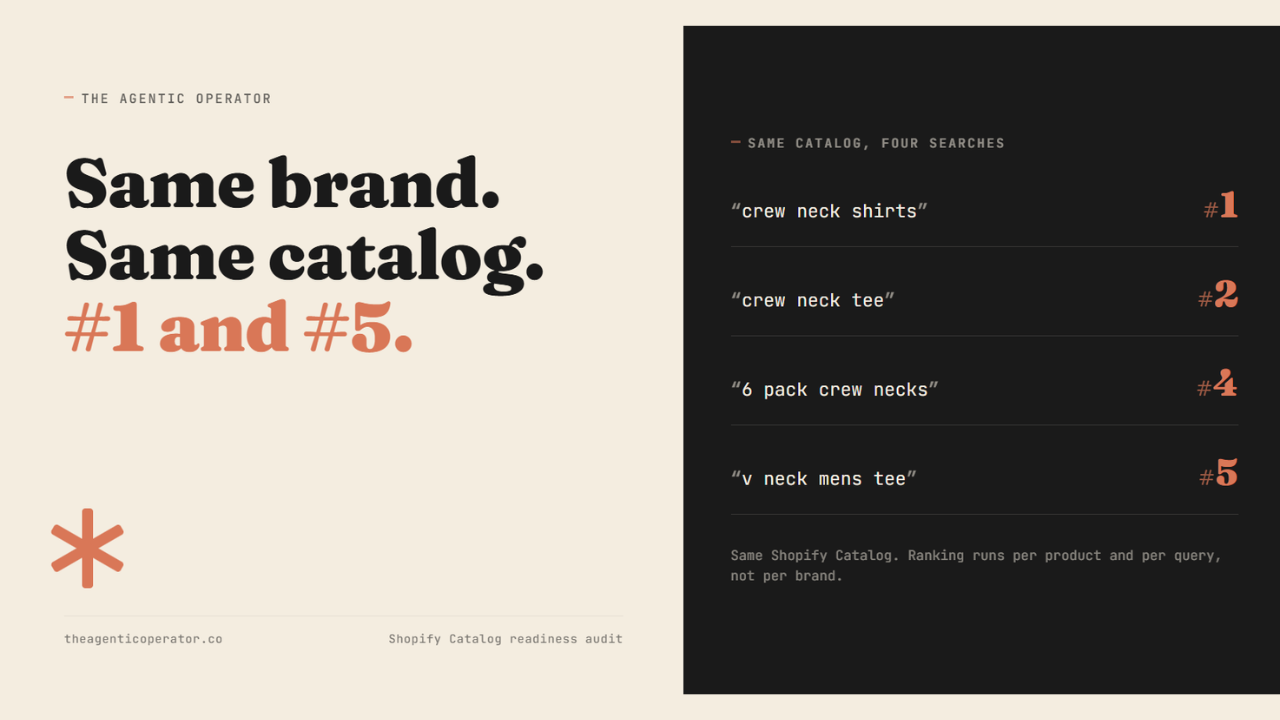
Four searches returned four different results, same catalog:
→ "crew neck shirts" - True Classic at #1, holding three of the top four spots
→ "crew neck tee" - #2, holding two of the top four
→ "6 pack crew necks" - #4
→ "v neck mens tee" - #5, outside the top four shown entirely

The searches closest to the plain, single-item version of what True Classic sells are the ones it wins. Add a specific framing - a pack size, a different neckline - and it drops, in one case out of the results shown entirely.
That's not a simulation. Shopify runs these same searches against the live Catalog API, so what comes back is what agents see.
Ranking runs per product and per query, not per brand.
What a 70 actually measures
True Classic's catalog readiness score came back 70 out of 100, across 420+ products.

Same rule as every audit I've run through here: the number is an average of exactly two things - description completeness and structured attributes. True Classic's description completeness came back at 97. Structured attributes came back at 42. One signal is close to perfect. The other is what's holding the score at a C.
The same gap Gymshark had

The product that lost the "6 pack crew necks" search, the Staple Classic Crew Neck 6-Pack at $119.99, has 2 of 7 category attributes structured - Color and Size. Target gender, activewear clothing features, activity, and age group aren't structured at all. Fabric isn't either, though Shopify's guessing "60% cotton, 40% polyester" as a free-text inference instead of an actual metafield - the same pattern Gymshark's card showed.
The description gap runs the same direction too. 63 words on the storefront, 16 reached.
Where to start
Structure Color, Size, and Target gender first - Target gender is the one most catalogs skip, and it's the gap costing the most matches.
Check what's reaching the catalog feed, not just the storefront - a thin gap between what you write and what actually reaches Shopify Catalog is a fixable data problem, not a content problem.
Go deeper once those two are solid - fabric, activewear clothing features, and whatever else your category unlocks are checked in the full report but don't move the headline score. They still feed the live ranking.
Structuring this across a real catalog is where merchants stall, which is the reason Atomz exists. → Get Atomz on Shopify
Run the free audit on your own catalog, or book a strategy call - if you want a free walkthrough of your audit report.
- Ankit
If this was useful, the next one will be too.
Weekly. Free.
Unsubscribe with one click.
