Meta is putting AI agents on both sides of the sale
and buy for your shoppers
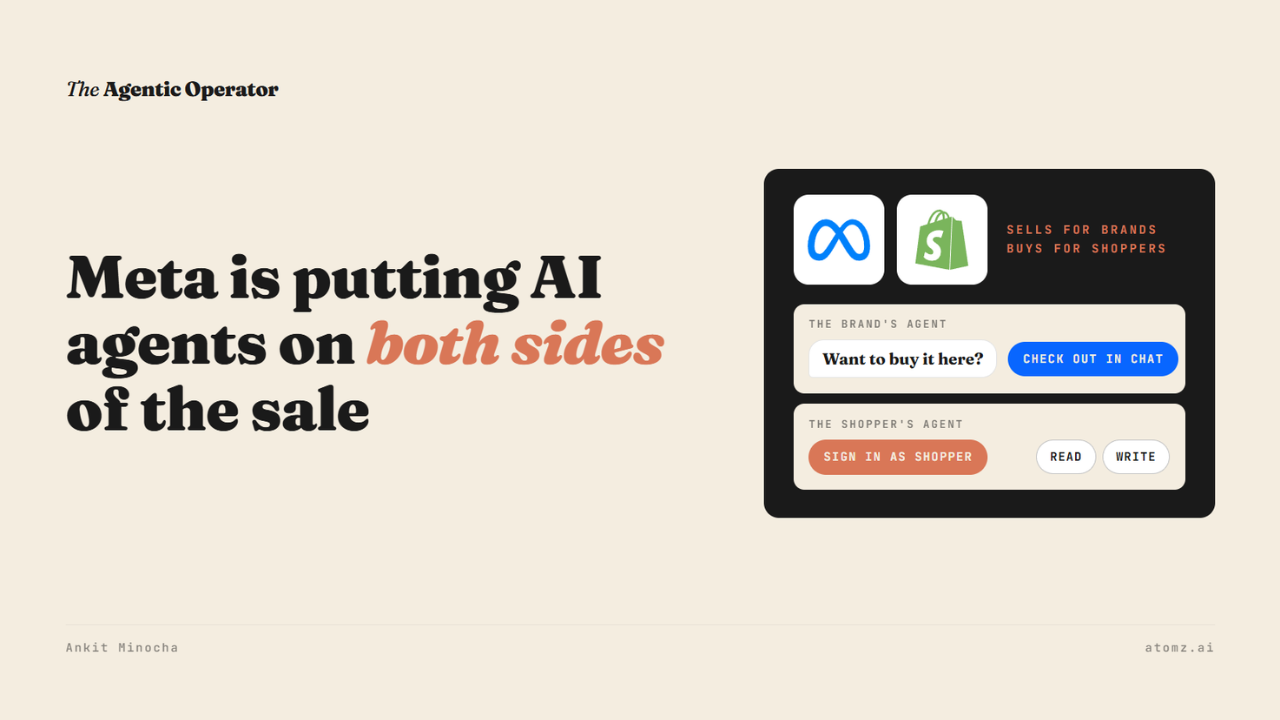
Meta made two moves last week that put AI agents on both sides of a sale.
Business Agent checkout - Meta is testing checkout inside a brand's own AI agent on Messenger, with Shopify
A sign-in standard - Meta and partners including Shopify, Stripe and Walmart proposed a common way for a shopper's personal agent to sign in to a store
The brand's agent takes the order
A shopper asks a brand's Business Agent about a product on Messenger, then buys it in the same chat. It's a test for now.
The agent itself is live on WhatsApp and Messenger. Meta started bringing it to Instagram a few months back.
Meta also said it will start testing checkout in Meta AI this fall, with Adyen, PayPal, Shopify and Stripe. And Muse is adding PayPal, next to Link by Stripe and Shop Pay.

Source: Meta
In the Messenger test, the purchase comes right after the agent's answer. What it knows about your products shapes that answer.
Meta says the agent learns from your Facebook Page, past chats and website. You can also upload product catalogs and price lists.

Source: Meta
Meta hasn't said which product catalog the Messenger test reads. For a Shopify store, the catalog Meta holds usually comes from the Facebook & Instagram channel. Either way, the answer comes from your product data.
Most of what shoppers ask about isn't in a field yet.
Across 400,000+ live Shopify products, we found 51% of what a shopper asks about sits somewhere in readable text and only 6% of that is filterable.
When a shopper's AI does the buying
I asked Muse to buy a pair of sneakers from a Shopify fashion store.
It got the checkout ready and said it would pause for my approval before anything was charged. Then the purchase failed with a 416 error. Muse said the add-to-cart step was blocked and asked if I wanted to add it to the cart myself.

Muse shops by opening a browser and clicking through your site like a person would.
So a store can't easily tell an agent from a shopper. Amazon blocked Muse last month, saying it doesn't identify itself when it browses.
Shopify went the other way and opened its stores to Muse. A few weeks back I shared what that changes on your side.
The new standard, called the Personal Agent Protocol, tries to fix the identity problem. The shopper signs in on the store's page or through their agent, then picks read-only or write access. The store decides what agents can do.
A store can let agents in three ways.
Through its normal website
Through APIs built on standards like MCP and OpenAPI
Through the store's own agent, for things that need a conversation, like a warranty claim
It's built on OAuth, the sign-in method behind "Sign in with Google". The first version of the spec is due later this month. Payments may come later as an extension.
Four checks to do
1/ Open Meta Business Suite > All tools > Meta Business Agent. Test its replies before you switch it on for customers.
2/ Chat with it like a shopper about your top five products. Ask about sizing, shipping and stock - see how it responds to questions.
3/ In the Facebook & Instagram channel in Shopify, check which products sync to Meta.
4/ In Shopify, Sales channels > Agentic controls direct checkout for Meta AI and Muse, which lets shoppers buy without leaving Meta. It's on by default. To change it, turn off "Allow Shopify to manage for me" and open Meta AI and Muse.
Meta has agents selling for brands and buying for shoppers - both read your product data first. The Shopify Catalog audit shows what an AI agent reads from your catalog and how you compare with competitors for the same shopper queries.
Atomz AI fills in category attributes across your catalog, so an agent has the details shoppers ask about. Get in touch for a demo.
- Ankit
If this was useful, the next one will be too.
Weekly. Free.
Unsubscribe with one click.
