Shopify Catalog readiness audit for brands selling on AI channels
Shopify's Spring '26 Editions was explicit about what the agent network measures: five listing-quality signals, three attributes agents can filter on today, and what happens to your product data when those fields are empty. If you missed it, breakdown here.
That gave us a few more clear benchmarks - so we updated the AI readiness audit to show you exactly where your catalog stands on each of those signals, and to run your products against live Shopify Catalog queries so you can see how you rank.
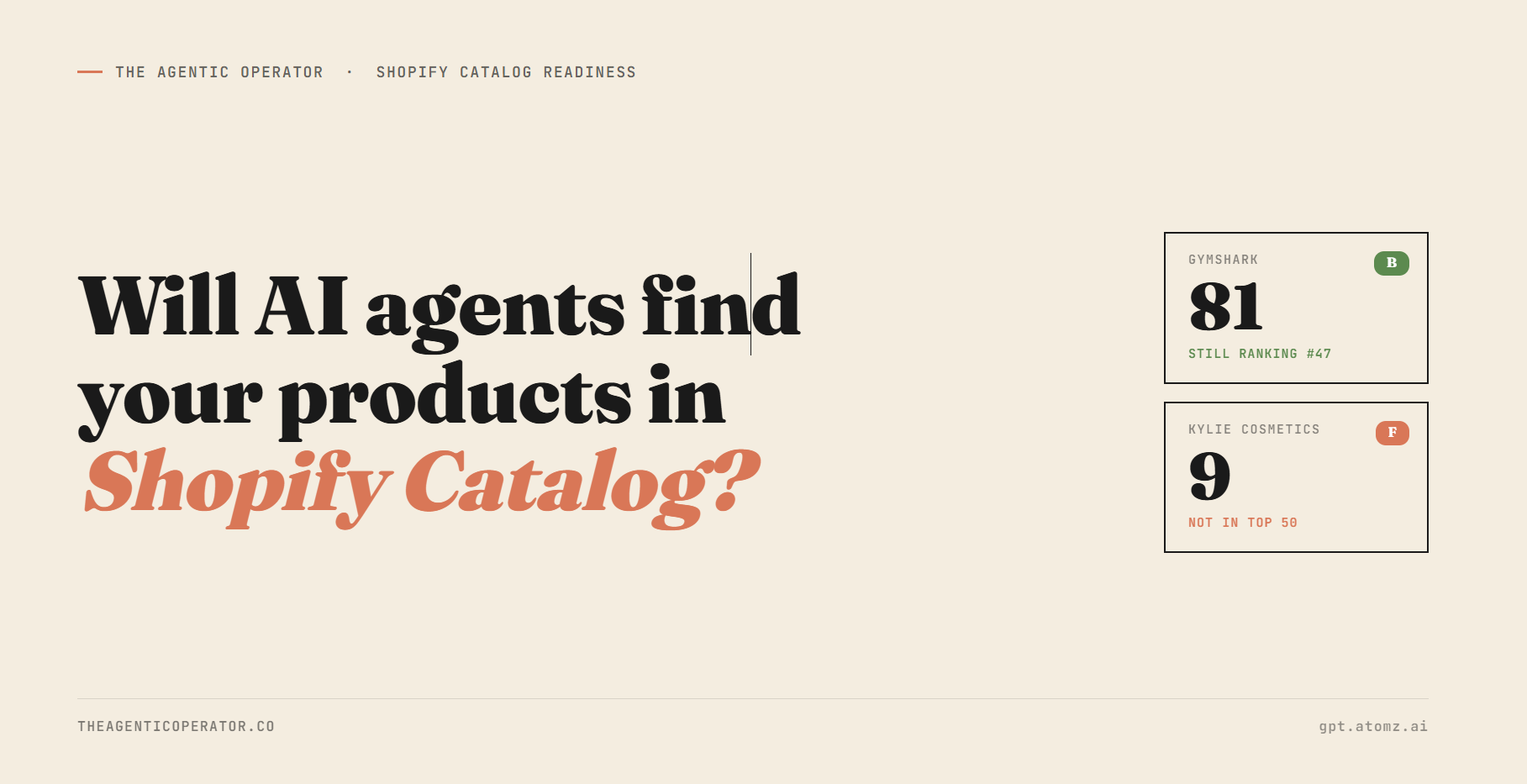
I ran it on a few brands - like Gymshark, Allbirds, and more. The scores came back very different. The one brand with a score of 81, ranked #47 for a query it should own. Another one with 9 did not appear in the top 50 results for any query.
Here is what the full report now shows:
→ How an AI agent reads your products
→ Does this product win the queries it should?
→ Catalog readiness score
→ Shopify Catalog inclusion
→ Shopify's five listing-quality signals
→ Attributes agents filter on today
→ What your store tells AI agents
→ What to fix first
1 - How an AI agent reads your products
When you enter a store URL, the audit pulls a sample product directly from Shopify Catalog - the same feed Shopify sends to ChatGPT, Copilot, and Gemini - and shows you exactly what the agent receives. There are two layers.
First, which attributes are structured and filterable, and which Shopify has only inferred from your product text. Inferred attributes sit in the catalog payload, but agents cannot filter on them - a shopper specifying a material, fit, or ingredient cannot reliably be matched to your product on those terms.
Second, below the attribute state, it shows the ML-inferred data Shopify generated from your description, so you can see what Shopify guessed and whether that guess is accurate.

For this Gymshark t-shirt, three of seven attributes are structured. The description is too thin for an agent to match to a natural-language query. Color and Size are structured correctly, as is Activity. Target gender, activewear clothing features, age group, and clothing features are not. Below the card, Shopify's inference shows material, fabric density, fit, and care instructions - none of which agents can filter on.
2 - Does this product win the queries it should?
The second part of the audit runs your product against the global Shopify Catalog for a real shopper query - the same index AI shopping agents search. It shows your position, and what shoppers see if you are not in the top results.
The tool suggests four queries the product should match based on its category and attributes. You can type your own. The results are live.

Ritual - query tested: "supplements for gut health"
For Ritual, a supplements brand with 30 products, the query "supplements for gut health" returns nothing from their catalog in the top 50. A shopper asking AI that question sees Naked Nutrition, Snap Supplements, and Young Again - not Ritual, whose Synbiotic+ is built directly for that use case.
3 - Catalog readiness score
The score runs from 0 to 100 and reflects how visible your products are to AI agents searching the Shopify Catalog, and is an equal-weighted average of two signals: Description completeness and whether your catalog has Color, Size, and Target gender structured as filterable data.

80+ means your products clear Shopify's listing-quality bar and rank in the layer - agents search first. Between 50 and 80, you are in the catalog but losing rank to competitors with better data. Below 50, you are ranking low enough that AI shoppers will not reach you.
Gymshark and Allbirds each have one signal pulling their score down. Gymshark's descriptions score 97, but structured attributes sit at 65. Allbirds runs opposite - structured attributes at 100 across 360 products, descriptions at 50 with 44 products below the word-count threshold for AI matching.
4 - Shopify Catalog inclusion
Before ranking signals are applied, a product has to meet Shopify's basic inclusion requirements: a title and at least one image, a price above zero, a URL that resolves, a publicly reachable store, a Starter plan or higher, and shipping to the US or Canada. If yours does not, your products are not in the agent network.
5 - Shopify's five listing-quality signals
The score overview covers two signals. The full report shows all five Shopify uses to rank products in the Catalog, each with a specific finding for your store.
Description completeness - how complete your product descriptions are. Short descriptions give agents less text to match to natural-language queries.
Image coverage - number of images per product. Agents can represent your product across more shopping contexts with more images.
Variant and option completeness - whether option names are readable labels like Color and Size, or generic placeholders like Title and Option1 that agents cannot interpret.
Shop policy completeness - shipping, refund, privacy, and terms policies are all publicly accessible. Policies signal store legitimacy to AI channels.
Product reviews - whether verified reviews are in a format Shopify can count on. Reviews that cannot be verified do not contribute to the ranking signal.
6 - Attributes agents filter on today
Shopify Catalog lets agents filter on three attributes: Color, Size, and Target gender. Those are the only fields a shopper can use to narrow a search through an AI agent today. Everything else - materials, active ingredients, fit type, care instructions, cosmetic function - Shopify infers from your product descriptions, and those inferences are not filterable. Agents cannot narrow down on them reliably.
The audit shows the percentage of your catalog with each of the three filterable attributes structured, alongside the deeper category-specific attributes that sit in the payload but agents can only guess at today.

Gymshark - Color and Size structured, Target gender at 0%
For Gymshark, the target gender is at zero. Someone asking an agent for women's gym tops or men's oversized tees is filtering by gender. Because gender is unstructured, that filter does not connect to Gymshark.
The deeper activewear attributes - activewear clothing features, age group, clothing features - sit in the payload and affect ranking, but agents cannot filter on them today. Filling them now means your catalog is ready the day filtering expands.
7 - What your store tells AI agents
Shopify auto-serves three files agents read before querying your products: agents.md (the canonical agent guide), llms.txt, and llms-full.txt. A customised version tells agents what your store sells, how it is structured, and what it does best. A default skeleton gives them almost nothing. To check your own, go to yourdomain.com/agents.md.
8 - What to fix first
The report closes with fixes ranked by impact on Shopify Catalog rank.
Also shows what the structured product looks like once the gaps are closed.

For Kylie Cosmetics primer, the first fix is expanding thin descriptions so agents can match products to queries. The second is structuring Color, Size, and Target gender across 224 products. Third is connecting a verified review source that Shopify can use.
For the first two, Atomz AI structures and enriches this automatically.

Take the audit for free.
Enter your store URL - you will see your score, the query test, and the full report across all eight sections. If you want to go through what fixing this looks like for your brand, book a free strategy call with me. Calendar here →
- Ankit
If this was useful, the next one will be too.
Weekly. Free.
Unsubscribe with one click.
