Shopify product data that AI needs to find your product
Here's what happens when you fix the product data.
One of the key takeaways from Shopify's AI discovery session at DotDev was that the product spec now answers the query. Get the category wrong or skip it and that product becomes invisible to the exact query that would have converted.
Same shift in different platforms
Amazon's Alexa, Home Depot's assistant, and Sephora's chat interface are all nudging shoppers to ask questions rather than type keywords.
None of that works without structured data underneath to match the question against. Shopify pointed to this as evidence the shift is happening industry-wide.
From keyword to use case
Earlier - in a usual shopping journey - on a storefront, a shopper used to type "shorts" into a search bar and browse until something looked right.
That's not how it works anymore.
Now when someone asks ChatGPT or Gemini for shorts, they're starting from a reason, not a word - swim shorts, running shorts, something for a hot commute.
The query already carries the use case.
The product either answers it or it doesn't show up. Whether that listing surfaces for a swim query or a running query has nothing to do with the title or the photos.
It comes from category metafields. Those only exist because of a fixed mechanism underneath - assign the right category to a product. And Shopify opens the exact attribute set that matters for it: material, closure, intended use, fit, for a pair of shorts. Skip the category or get it wrong, and none of those fields exist to fill in.
What missing metafields cost you

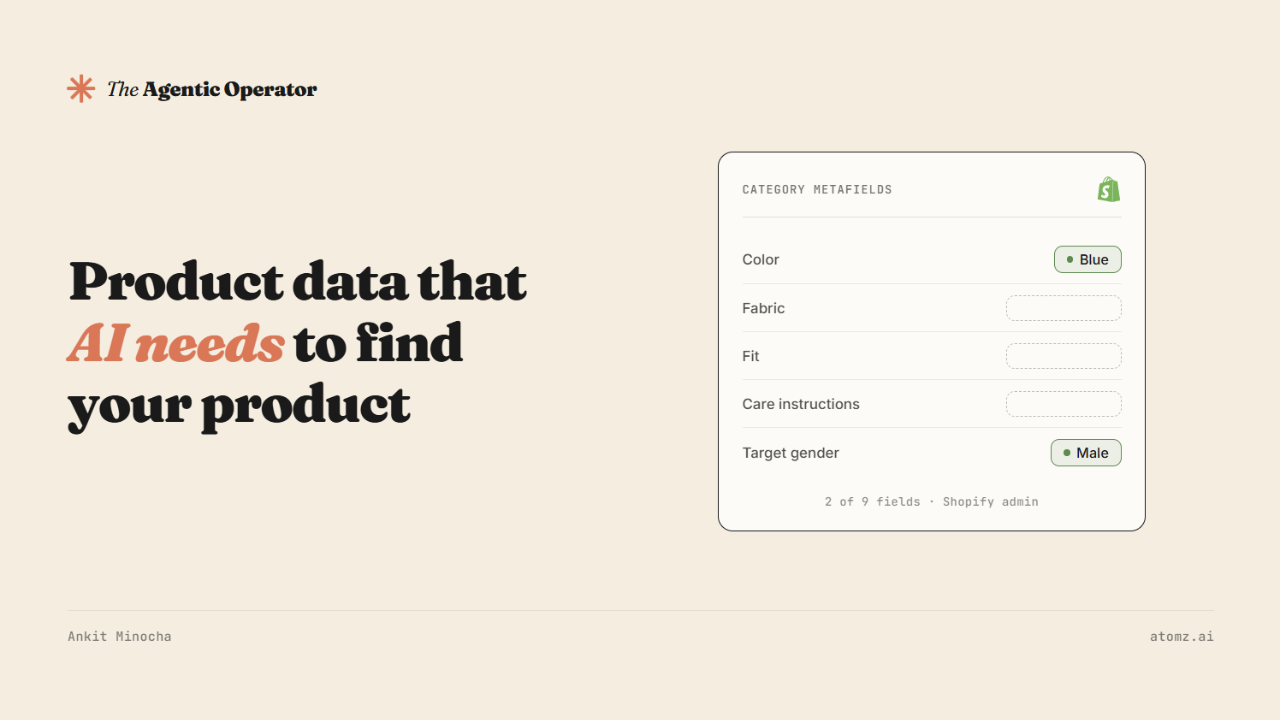
Category metafields in Shopify admin
Two of the nine category fields are filled in: color and target gender. The other seven, including fabric, fit, and care instructions, are empty.
For a query, none of the fields that would answer it exist yet. However well the product fits, there's nothing there for that query to match against.
Brands sit exactly like this by default. Filling these in across hundreds or thousands of SKUs is the part almost nobody gets to - the biggest visibility gap.

Atomz dashboard
Same product, run through the Atomz AI. Fabric, care instructions, and clothing features are filled in. AI reads every product it touches instead of guessing.
The same fields power your AI discovery
This isn't limited to the agent shopping or external AI channels. Your on-site search and assistant read from the same enriched catalog on your Shopify admin.
It's the same mechanism that Ulta, Amazon, Walmart are all building.
Pull up your best-selling products in Shopify admin and check whether the category-specific fields are populated, beyond the title and description. Most aren't.
If you'd rather have it filled in automatically, Atomz AI does this best.
- Ankit
If this was useful, the next one will be too.
Weekly. Free.
Unsubscribe with one click.
