UCP adds a return policy format for AI agents
and where Shopify keeps yours
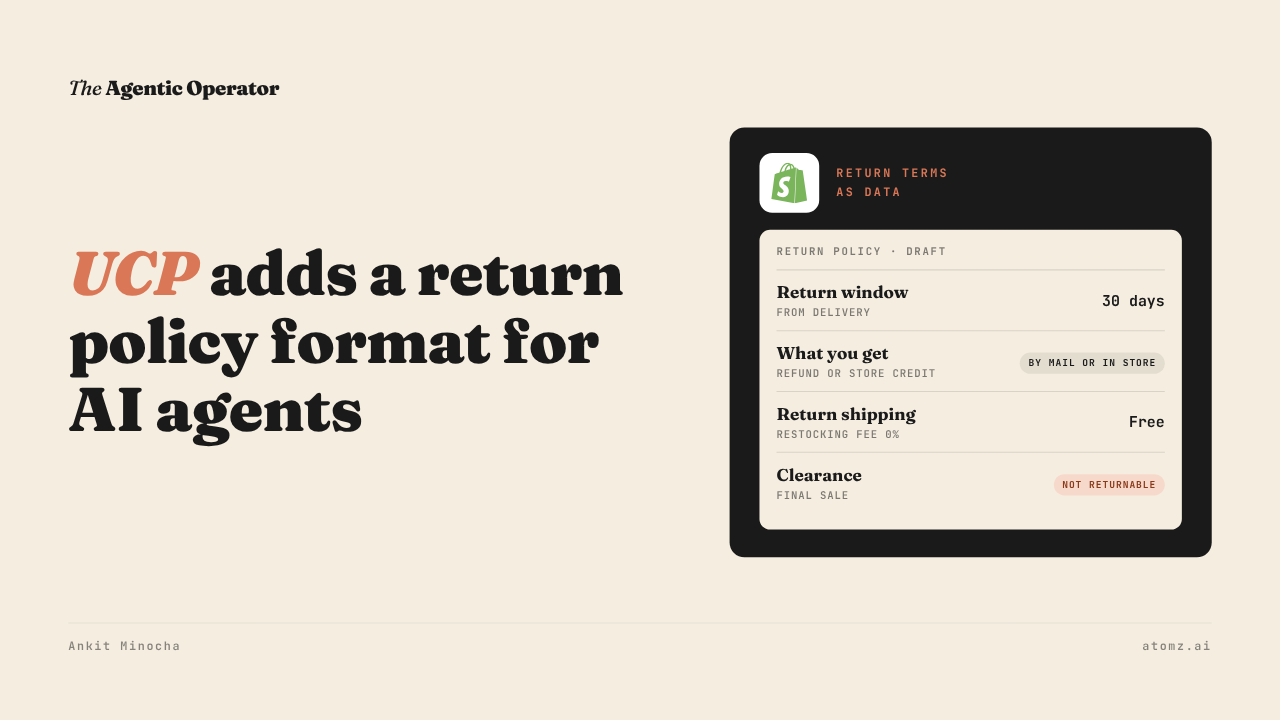
UCP, the protocol AI agents use to shop with stores, added a way for stores to state their return terms as data.
It landed last week and covers how long a shopper has and what they get back. It also covers how they send it, what it costs and whether an item can be returned at all.
It's in the draft version of the spec and not in a release yet.

Source: Universal Commerce Protocol
Last week I shared how to open your store's UCP file, where Shopify lists what agents can do on your store. The return terms are built to come along with your product, cart, checkout and order data.
What the new extension covers
UCP's spec puts the problem plainly. One policy page often covers standard terms, final-sale items and category exceptions in prose. An agent can't tell which terms apply to a given product.
The extension lets a store state them per product.
The window - like 30 days from delivery. The store has to say when the clock starts (at purchase, when it ships or on delivery)
What the shopper gets - a refund to the original payment, store credit, a gift card, an exchange or a replacement
How it goes back - by mail, in store or at a kiosk
What it costs - a restocking fee, return shipping or a handling fee
Final sale - marked as not returnable
Once the clock starts on an order, the store can also give its exact return-by date.
Where return terms sit today
A test of 122 Shopify stores published this month looked at this. 70% of the stores whose policy text could be read wrote a return window in prose.
Only 7% of product pages carried it as structured data.
Shopify already keeps the window, the return fees and final sale items as settings in your return rules.

Source: Shopify admin
You can set a return window, including a custom or unlimited one. Return shipping can be free, a flat fee or the shopper's own label. You can add a restocking fee and mark collections or products as final sale.
Shopify's help page adds one detail. In the Shop app, product pages can show your return window when it's set in return rules. A policy that's text alone won't appear.
Return rules look like the closest thing in your admin to what UCP now describes.
Agents can already find your shops
One part of this works today. On October 22, Shopify let agents search a store's physical shops and check which of them carry the items a shopper wants.
It applies to stores with an active retail location set up as a physical storefront. An agent can check up to 10 items at once. A shop matches when every item is available there.
Shopify says it isn't a stock count or a pickup promise. Store hours and picking up an order at a chosen shop aren't supported.
I opened the UCP file on two Shopify stores. The one with shops listed both location tools. The one that sells online without shops didn't.

Source: a Shopify store's UCP file
Four checks on what agents see in your store
1/ Go to Settings > Policies and open Return and cancellation rules. Set your window, when it starts, return shipping and any restocking fee.
2/ Mark your final sale collections or products in the same place, especially anything you're clearing for Black Friday.
3/ If you have shops, go to Settings > Locations and open each one. Add the full address and turn on Physical storefront, which shows the shop to AI agents.
4/ Open yourstore.com/.well-known/ucp and look for dev.ucp.common.location.search in the list.
The Shopify Catalog audit shows the product data an agent reads next to your return terms and how it compares with competitors. Audit now →
Atomz AI fills in category attributes across your catalog, so the product data an agent reads is as complete as your policies. Get in touch for a demo.
- Ankit
If this was useful, the next one will be too.
Weekly. Free.
Unsubscribe with one click.
